Redundancy Rights NZ: What You're Entitled To

Imagine clocking in at your job every day, only to hear the words "your role is being made redundant." It's a gut punch that hits thousands of Kiwis each year, especially in tough economic times. But...
The Lifetimes NZ editorial team curates, fact-checks, and updates guides on personal finance, property, health, immigration, legal, business, and lifestyle topics relevant to Lifetimes NZ readers. Articles are produced with AI assistance and reviewed by the editorial team before publication.
Imagine clocking in at your job every day, only to hear the words "your role is being made redundant." It's a gut punch that hits thousands of Kiwis each year, especially in tough economic times. But here's the good news: New Zealand employment law gives you clear redundancy rights, ensuring employers can't just cut corners. Whether you're facing restructuring or outright job loss, knowing what you're entitled to can protect your finances and peace of mind.
In this guide, we'll break down everything from notice periods to potential payouts, straight from official sources like Employment New Zealand. We'll cover the 2026 landscape, including upcoming law changes, so you can navigate this with confidence. Let's dive in.
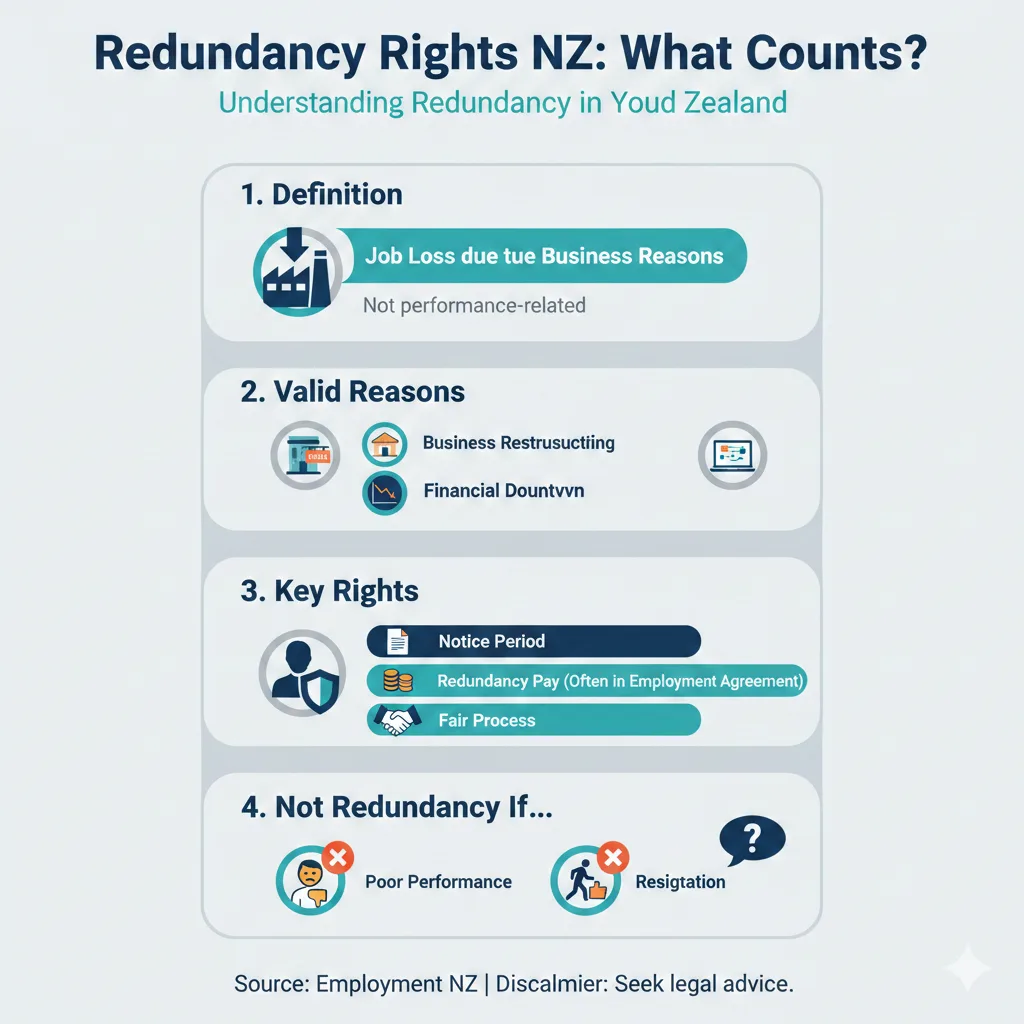
What Counts as Redundancy in New Zealand?
Redundancy happens when your employer no longer needs your specific job done the same way—think company restructures, automation, or economic downturns. It's not about your performance; it's about the role itself becoming obsolete. Importantly, it must be a genuine redundancy. Courts and the Employment Relations Authority (ERA) scrutinise this closely: was there real consultation? Were redeployment options explored? If not, it could be ruled an unjustified dismissal.
Under the Employment Relations Act 2000, employers must treat redundancy as a last resort. They have to explore alternatives like redeployment before pulling the trigger. For Kiwis, this means your employer can't use redundancy as a sneaky way to ditch you—doing so opens them up to personal grievances and compensation claims.
Voluntary vs Forced Redundancy
Not all redundancies are forced. Many employers offer voluntary redundancy packages to avoid forced cuts, especially in larger restructures. These often include enhanced payouts or extra support, but they're not mandatory unless your employment agreement says so.
- Voluntary: You opt in, often for a better package. Common in sectors like manufacturing or tech during downsizing.
- Forced: Selected based on objective criteria like skills or seniority. Must follow fair process to avoid unfair dismissal claims.
Pro tip: If voluntary redundancy is on the table, negotiate. Review your agreement and consider getting free advice from Employment New Zealand before signing.
Your Key Entitlements: Notice, Pay, and Support
Kiwi law doesn't mandate redundancy pay automatically—that's a myth many fall for. You're only entitled if it's in your employment agreement, collective agreement, or established workplace policy. However, notice periods are non-negotiable, and other supports kick in.
Notice Periods Explained
Every employee must get written notice matching their employment agreement—typically 2-4 weeks for most roles, but check yours. During this time, you're paid as usual, even if not working (unless you both agree to waive it). No notice specified? The law defaults to a reasonable period based on your role and tenure.
| Tenure | Typical Notice (Individual Agreements) | Example Sectors |
|---|---|---|
| 0-6 months | 2 weeks | Retail, hospitality |
| 1-5 years | 4 weeks | Office, admin |
| 5+ years | 4-8 weeks or more | Professional services |
Note: These are guidelines; your contract rules. Long-server Kiwis in unionised workplaces often secure more.
Redundancy Compensation: What to Expect
No statutory minimum, but common packages follow industry norms: 1-2 weeks' pay per year of service, capped at 8-12 weeks. For example, a 10-year veteran might get 10-20 weeks' pay. Always tied to your agreement—review it now.
Beyond pay, employers should offer:
- Redeployment options within the company.
- Outplacement support: CV help, interview coaching, career counselling.
- Extended notice if the role lingers longer than expected.
- Training for future jobs.
In 2026, with economic pressures from global events, more firms are sweetening deals to retain goodwill. But if it's missing from your agreement? Negotiate or seek mediation.
Final Pay and Holidays
You're always entitled to accrued holidays, regardless of redundancy. Employers must pay out unused annual leave at your normal rate, plus any alternative holidays. KiwiSaver contributions continue until your last day—check with your provider. IRD requires tax on payouts, but redundancy pay is often taxed at a flat 10.5% if under thresholds (confirm via ird.govt.nz).
The Redundancy Process: What Employers Must Do
A fair process protects both sides. Employers must:
- Propose changes: Share a written proposal explaining why roles are at risk.
- Consult: Meet with affected staff (or unions) to discuss impacts and alternatives. This is mandatory—no shortcuts.
- Explore redeployment: Check internal vacancies you could fill, even at lower pay if reasonable.
- Decide and notify: Confirm in writing, with notice and support details.
Skip steps? You can file a personal grievance with the ERA within 90 days. Successful claims have won $20,000+ in distress compensation. Real Kiwi case: In 2024, the ERA awarded remedies after a flawed text-message dismissal.
"A redundancy is treated by the Courts as a dismissal, therefore it must be genuine and carried out in a procedurally fair way."
2026 Employment Law Updates: What Kiwis Need to Know
2026 brings tweaks via the Employment Relations Amendment Bill, expected early this year with a 12-month transition. Key for redundancies:
- High-income threshold: High earners ($200k+ total remuneration) face limits on unjustified dismissal claims, unless opted out. Includes bonuses/shares.
- Pre-termination negotiations: New framework for agreed endings, with written settlements as full/final. Protects against grievances.
- No major redundancy pay mandates yet, but watch for Fair Pay Agreements in low-wage sectors.
Stay updated via employment.govt.nz—these don't overhaul entitlements but refine processes.
Practical Tips: Protecting Yourself During Redundancy
Don't panic—act smart:
- Document everything: Emails, meeting notes. Build your case if needed.
- Seek free advice: Call Employment New Zealand (0800 20 90 20) or Community Law Centres.
- Negotiate extras: Reference letters, extended health cover, or payout top-ups.
- Job hunt early: Use Trade Me Jobs, Seek NZ, or WINZ support. ACC might cover if injured during transition.
- Financial buffer: Check KiwiSaver withdrawals (first home) or WINZ benefits like Jobseeker Support.
For finances post-redundancy, track IRD for tax credits and update your myIR account. Professional advice recommended—see a financial adviser for personalised KiwiSaver/ACC strategies.
FAQ: Common Redundancy Questions from Kiwis
1. Am I entitled to redundancy pay if not in my contract?
No, it's not automatic. Check your agreement or policy—otherwise, negotiate.
2. What if I think the redundancy isn't genuine?
Raise it during consultation, then file a personal grievance with the ERA within 90 days. Seek legal help.
3. Can I work my notice period from home?
Yes, if agreed. You're paid regardless.
4. How does redundancy affect my KiwiSaver?
Contributions stop on your last day, but you keep your balance. Employer matches until then.
5. What's changing in 2026 for high earners?
$200k+ threshold limits some dismissal claims—opt out via agreement.
6. Where do I get redundancy support?
Employment NZ helpline, or mediation via MBIE.
Next Steps: Take Control Today
Facing redundancy? Review your employment agreement now, contact Employment New Zealand, and line up your support network. With genuine processes, it's a restructure—not a dead end. Many Kiwis bounce back stronger, landing better roles with their entitlements intact. For tailored financial advice, consult a licensed adviser—this isn't it. Stay proactive, and you'll weather this.
Disclaimer: This is general info for 2026. Seek professional advice for your situation.
Related Articles
Working Multiple Jobs NZ: Tax and Legal Considerations
Juggling multiple jobs can boost your income, but it's crucial to understand the tax implications and legal requirements that come with working more than one role in Aotearoa. Whether you're a contrac...

Name Changes NZ: Legal Process and Costs
Considering a fresh start with a new name? Whether it's after marriage, divorce, or simply embracing a personal transformation, changing your name in New Zealand is straightforward but requires follow...

Holiday Home Tax Rules NZ: Private Use and Rental
Own a bach in Coromandel or a holiday home in Queenstown? You're not alone—many Kiwis cherish these escapes, but renting them out while enjoying personal use can trip you up on tax rules. Getting the...

Industry Bodies and Professional Associations NZ
Whether you're launching a business, advancing your career, or navigating financial regulations, industry bodies and professional associations in New Zealand offer invaluable support. These organisati...