Crypto Tax NZ: How to Report Bitcoin and Crypto

Ever bought Bitcoin on a whim, watched it skyrocket, then cashed out for a tidy profit? In Aotearoa, that thrill comes with a tax twist. The Inland Revenue Department (IRD) treats crypto like property...
The Lifetimes NZ editorial team curates, fact-checks, and updates guides on personal finance, property, health, immigration, legal, business, and lifestyle topics relevant to Lifetimes NZ readers. Articles are produced with AI assistance and reviewed by the editorial team before publication.
Ever bought Bitcoin on a whim, watched it skyrocket, then cashed out for a tidy profit? In Aotearoa, that thrill comes with a tax twist. The Inland Revenue Department (IRD) treats crypto like property, meaning your gains could land in your taxable income bucket—potentially up to 39% depending on your total earnings. Don't stress; this guide breaks down Crypto Tax NZ: How to Report Bitcoin and Crypto step by step, so you stay compliant without the headache.
What Counts as Taxable Crypto Activity in New Zealand?
Cryptocurrency isn't money in the eyes of the IRD—it's property. That means no standalone capital gains tax, but any profit from selling, trading, or using it is taxed as regular income. Kiwi investors need to know exactly when Uncle Sam (or in our case, the IRD) comes knocking.
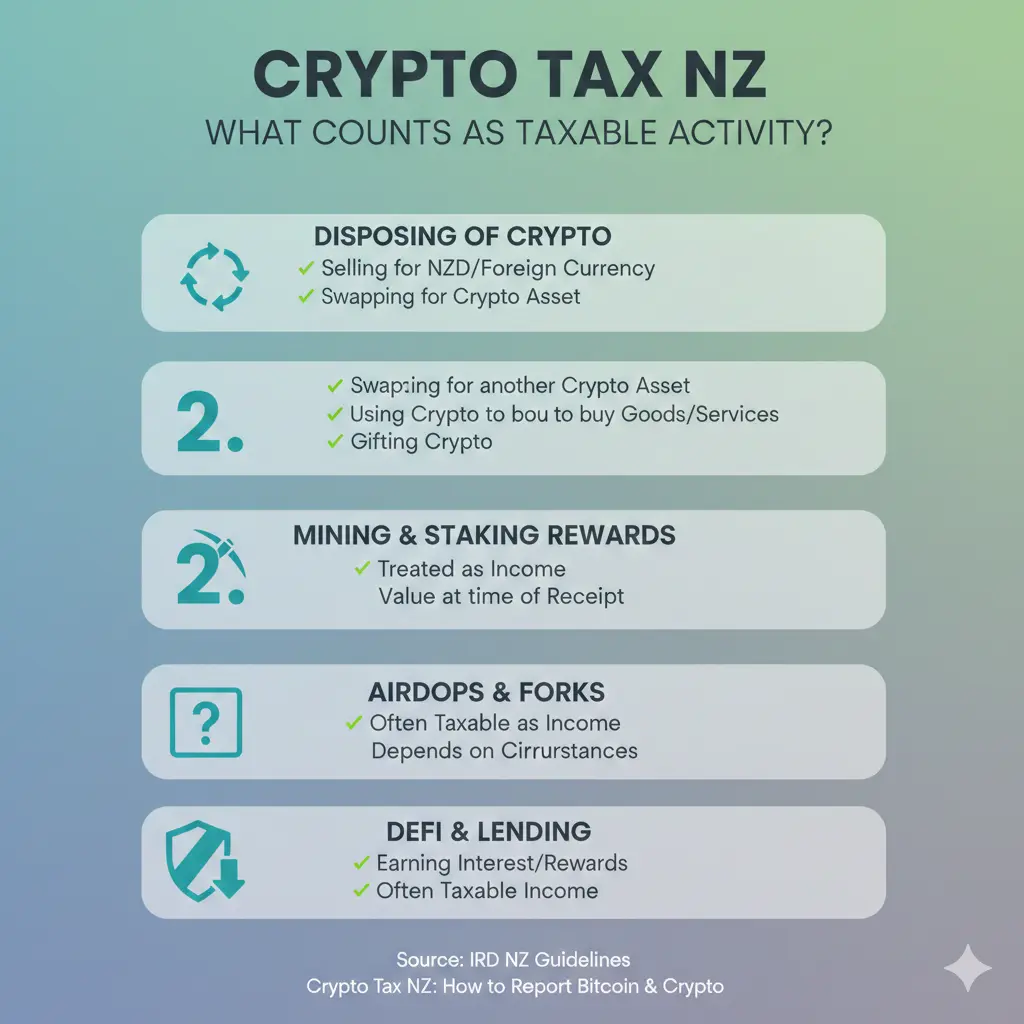
Taxable Events You Must Watch For
- Selling crypto for fiat (like NZD): If you bought Bitcoin at $50,000 and sold at $80,000, that $30,000 gain is taxable income.
- Trading one crypto for another: Swapping Ethereum for Bitcoin? The value difference at swap time triggers a gain or loss calculation.
- Using crypto to buy goods or services: Spending Bitcoin on a coffee? It's a disposal, taxed on the gain from your original cost.
- Mining or staking rewards: Freshly mined Ethereum or staking yields? Valued at fair market price when received, and taxed as income. Mining might also attract GST if it's a business-like activity.
- NFT transactions: Creating, selling, or buying NFTs with crypto—primary and secondary sales can be taxable, plus GST for NZ sales.
- Earning crypto (airdrops, referrals): Count it as income at receipt value.
What’s NOT Taxable?
Good news: simply HODLing your Bitcoin through ups and downs? Zero tax until you dispose of it. Wallet-to-wallet transfers between your own accounts also dodge the taxman—just keep records for later.
For new or returning Kiwis, there's a four-year "transitional resident" grace period where most offshore income escapes tax. Crypto gains might qualify, but watch for IRD updates—especially if traded on NZ exchanges.
How to Calculate Your Crypto Gains for IRD
Figuring gains isn't rocket science, but it needs precision. The IRD expects you to track cost basis (what you paid) against disposal value (what you got).
Step-by-Step Calculation Guide
- Determine your cost basis: Average cost if bought in batches, or fair market value for earned crypto.
- Calculate gain/loss per transaction: Disposal value minus cost basis. Example: Bought 1 BTC for $60,000 NZD, sold for $90,000—gain of $30,000.
- Aggregate all gains: Add up disposals, mining income, etc. Say you have $20,000 from BTC sales and $12,000 from staking: total taxable crypto income = $32,000.
- Add to total income: Combine with salary, rentals, etc., then apply progressive tax rates.
- Factor in deductions: Business miners can claim electricity, hardware costs. But casual holders? Slim pickings.
2025-2026 Tax Brackets
New Zealand's progressive rates apply to your total income, including crypto. For the 2025-2026 year (1 April 2025 to 31 March 2026):
| Income Threshold | Tax Rate |
|---|---|
| $0 – $15,600 | 10.5% |
| $15,601 – $53,500 | 17.5% |
| $53,501 – $78,100 | 30% |
| $78,101 – $180,000 | 33% |
| Over $180,000 | 39% |
Example: Earning $40,000 total (job + $10,000 crypto gain)? You'll pay tiered rates, not a flat hit.
"In New Zealand, there is no capital gains tax; instead, all capital gains are treated as income and taxed accordingly under the income tax regulations."
Record-Keeping: Your Best Defence Against IRD Audits
The IRD can track your trades via exchanges—many share data. Keep detailed logs: dates, amounts, NZD values (use reputable exchange rates), wallet addresses. Tools like Koinly or CoinLedger automate this, importing from 300+ exchanges.
Pro tip: Export CSVs annually. IRD's cryptoasset guidance stresses property-like treatment, so treat it like tracking shares.
How to Report Crypto on Your IRD Tax Return
Filing is straightforward via myIR portal—preferred over paper for edits and tracking. Deadlines: 7 July for non-working Kiwis, 31 March with an agent.
Filing Steps
- Log into myIR: Use your IRD number at ird.govt.nz.
- Complete IR3 return: Declare crypto income under "Other Income" or Schedule of Additional Income. No dedicated crypto box—bundle as property gains.
- Attach schedules: IR3I for investments, IR4 for businesses (miners).
- Pay up: Provisional tax might apply if over $5,000 income.
GST note: Businesses with turnover over $60,000 must register. Mining or NFT sales to Kiwis? GST at 15%.
Strategies to Minimise Your Crypto Tax Bill Legally
No loopholes to wipe it out, but smart moves help:
- Time disposals: Sell in low-income years to hit lower brackets.
- Offset losses: Crystalised losses reduce gains.
- Transitional status: Leverage the four-year offshore grace if eligible.
- Donate crypto: Check IRD rules for deductions.
- Use tax software: Automate calculations for accuracy.
Recent buzz: IRD seeks input on DeFi taxation as of Feb 2026—stay tuned via govt.nz.
Penalties for Getting It Wrong
Ignore crypto reporting? Expect fines, shortfall penalties up to 150%, even criminal charges for evasion. IRD's cracking down with exchange data. Better safe than scrambling.
Next Steps to Nail Your Crypto Taxes
Grab your transaction history today, plug into free trial software, and simulate your return. Consult a tax advisor or accountant familiar with crypto—Lifetimes NZ recommends pros via ird-approved lists. Bookmark ird.govt.nz/cryptoassets for updates. File early, sleep easy. You're now equipped to handle Crypto Tax NZ: How to Report Bitcoin and Crypto like a pro.
Disclaimer: This isn't personalised advice. Tax rules evolve—chat with a qualified advisor or the IRD for your situation.
Frequently Asked Questions
Sources & References
-
1
New Zealand Crypto Tax Guide 2026 - Kryptos.io — kryptos.io
- 2
-
3
New Zealand: Crypto Tax Rates (2026) - CoinLedger — coinledger.io
-
4
New Zealand Crypto Tax Guide 2026 - Koinly — koinly.io
- 5
-
6
Cryptoassets - Inland Revenue — www.ird.govt.nz
- 7
Related Articles

Small Business Tax Guide: What NZ Freelancers Need to Know
Freelancing in New Zealand offers the freedom to be your own boss, but it comes with the responsibility of handling your own taxes. Whether you're a graphic designer in Auckland, a consultant in Welli...

Tax Refund Secrets: How to Claim Every Dollar from the IRD This Year
Ever felt like the IRD owes you money but you're not sure how to get it back? You're not alone—many Kiwis leave hundreds of dollars on the table each year simply because they don't know the tax refund...

Best Accountant for NZ Property Investors
Owning rental properties in New Zealand can build serious wealth, but navigating the tax rules often feels like a minefield. The right accountant doesn't just file your returns—they spot deductions, s...
NZ Tax System Basics: PAYE GST and More
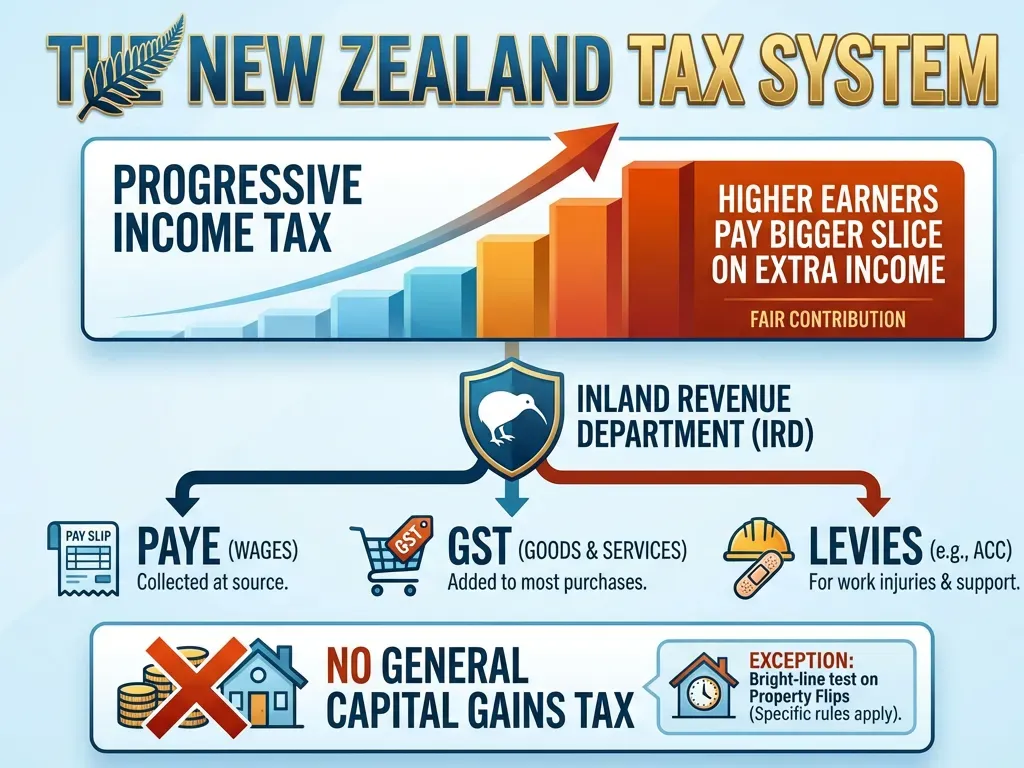
Ever wondered why your paycheck shrinks more than expected, or how that 15% added to your coffee bill funds our roads and hospitals? You're not alone—navigating the NZ tax system basics like PAYE, GST...