NZ Tax System Basics: PAYE GST and More
Ever wondered why your paycheck shrinks more than expected, or how that 15% added to your coffee bill funds our roads and hospitals? You're not alone—navigating the NZ tax system basics like PAYE, GST...
The Lifetimes NZ editorial team curates, fact-checks, and updates guides on personal finance, property, health, immigration, legal, business, and lifestyle topics relevant to Lifetimes NZ readers. Articles are produced with AI assistance and reviewed by the editorial team before publication.
Ever wondered why your paycheck shrinks more than expected, or how that 15% added to your coffee bill funds our roads and hospitals? You're not alone—navigating the NZ tax system basics like PAYE, GST, and ACC levies confuses many Kiwis. This guide breaks it down simply, with 2026 rates, real examples, and tips to keep more cash in your pocket.
What is the New Zealand Tax System?
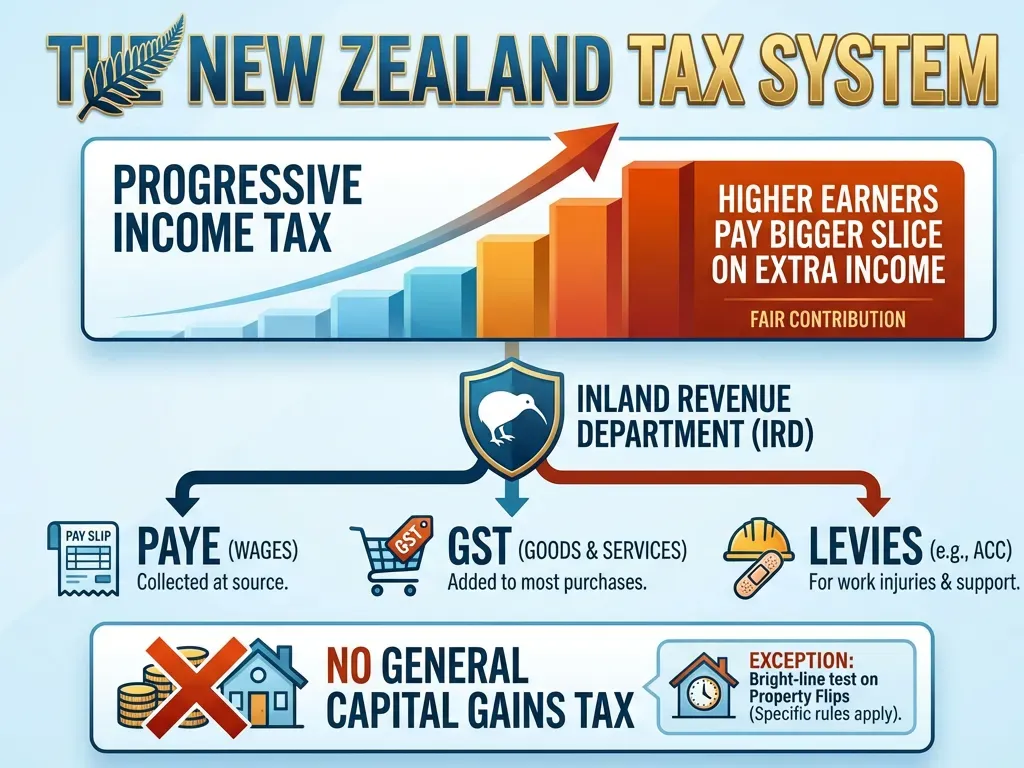
New Zealand runs a progressive income tax system, meaning higher earners pay a bigger slice on extra income. The Inland Revenue Department (IRD) collects most taxes through PAYE for wages, GST on goods and services, and levies like ACC for work injuries. Unlike some countries, we have no general capital gains tax—except for the bright-line test on property flips.
Our system funds Kiwi essentials: healthcare via Health NZ, Superannuation for retirees, and KiwiSaver contributions. In 2026, expect taxes on worldwide income if you're a resident, but only NZ-sourced income for non-residents. Key players include IRD for filings and ACC for levies deducted alongside PAYE.
Tax Year Basics
The NZ tax year runs 1 April to 31 March. For 2025-2026 (current as of 2026), use myIR portal to check deductions, file returns, or adjust tax codes. Tip: Log in annually to avoid surprises—overpaid tax means a refund!
PAYE: How Your Salary is Taxed
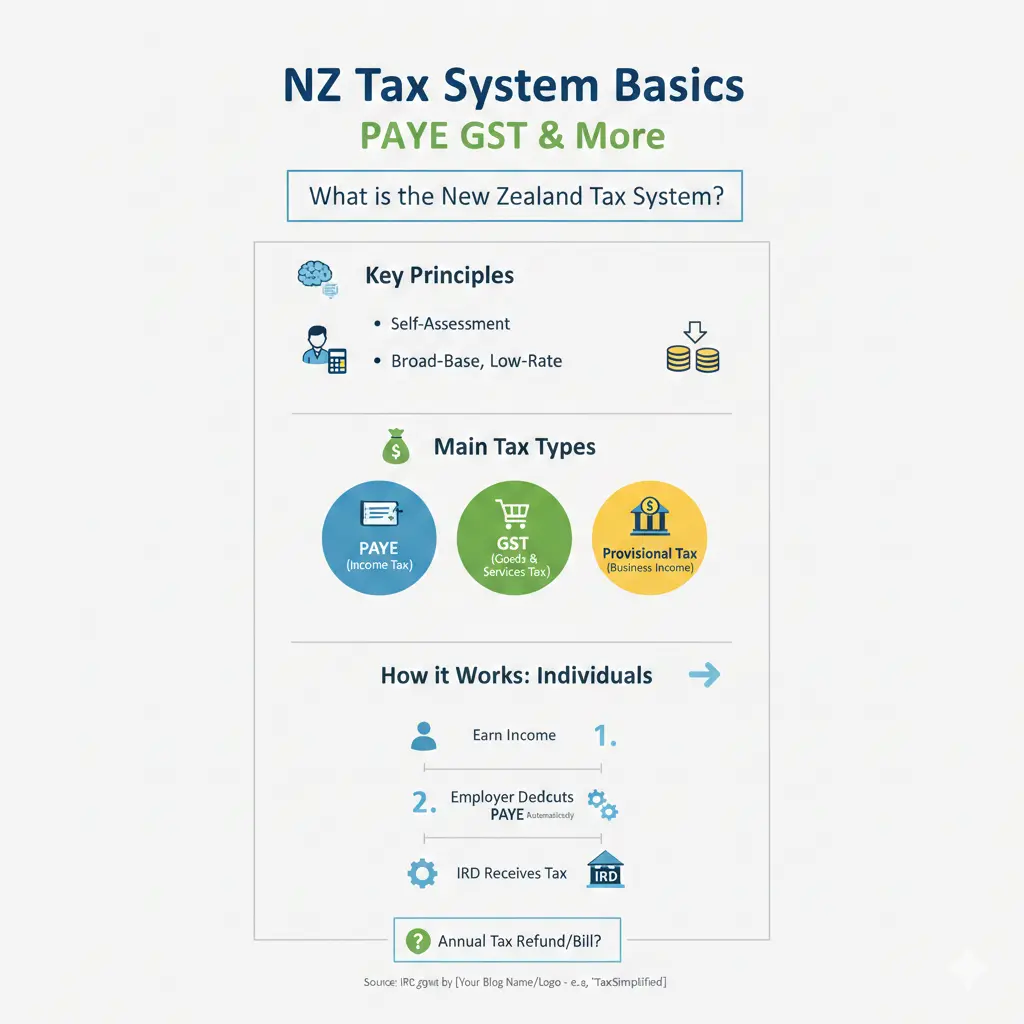
PAYE (Pay As You Earn) is deducted by employers straight from wages, covering income tax and ACC levies. It's the backbone of personal tax for most working Kiwis—about 80% of government revenue comes from income tax.
2025-2026 PAYE Tax Brackets
From 1 April 2025, five brackets apply progressively—only the income in each band gets that rate. Here's the breakdown:
| Income Range (NZD) | Marginal Tax Rate | Tax Owed Calculation |
|---|---|---|
| $0 - $15,600 | 10.5% | 10.5% of taxable income |
| $15,601 - $53,500 | 17.5% | $1,638 + 17.5% over $15,600 |
| $53,501 - $78,100 | 30% | $8,271 + 30% over $53,501 |
| $78,101 - $180,000 | 33% | $15,651 + 33% over $78,100 |
| $180,001+ | 39% | $49,277 + 39% over $180,000 |
Note: These thresholds adjusted from prior years (e.g., 2024 started at $14,000).
PAYE Examples for Everyday Kiwis
Earning $55,000? First $15,600 at 10.5% = $1,638. Next $37,900 ($15,601-$53,500) at 17.5% = $6,632.50. Last $1,500 at 30% = $450. Total tax: $8,720.50 (effective rate ~15.9%).
On $25,000? $15,600 at 10.5% = $1,638 + $9,400 at 17.5% = $1,645. Total: $3,283 (~13.1% effective).
Pro tip: Watch for bracket creep—salary rises pushing you into higher bands without real gain after inflation. Use IRD's tax calculator.
Secondary Jobs and Tax Codes
Multiple incomes? Use secondary codes like S (17.5% for $15,601-$53,500) or SH (30%). Pick wrong, face under/over-payment. Check via myIR.
- SB: $0-$15,600 at 10.5%
- S: $15,601-$53,500 at 17.5%
- SH: $53,501-$78,100 at 30%
- ST: $78,101-$180,000 at 33%
- SA: $180,001+ at 39%
GST: The 15% on Everyday Purchases
Goods and Services Tax (GST) is 15% on most buys—added at checkout, remitted quarterly by businesses to IRD. It hits groceries, fuel, and services but not rent, financial services, or exports.
As a consumer, you pay it indirectly. Businesses register if turnover exceeds $60,000/year, claiming input credits. Example: Buy a $10 flat white? $1.30 is GST funding public services.
GST for Small Businesses and Sole Traders
Sole traders charge GST on invoices if registered. Use accounting software like Xero to track. Tip: Voluntary registration under $60k lets you claim back business GST.
ACC Levies: Protecting Kiwis at Work
ACC (Accident Compensation Corporation) levies cover no-fault injury cover—deducted via PAYE (earners' levy) or business rates. For 2025-2026, expect ~1.5% on earnings up to $136,544 cap (rates adjust yearly).
Employers pay most, but it's visible on payslips. Self-employed? Pay via IRD as residual claims levy. No ACC? You're uninsured for work accidents—don't risk it.
Other Income Types and Taxes
Beyond PAYE:
- KiwiSaver/PIE Funds: Taxed at PIR (10.5% <$14k income, 17.5% $14k-$48k, 28% >$48k).
- Interest/Dividends: Resident Withholding Tax (RWT) up to 39%, auto-deducted.
- Property: No CGT on family home; bright-line tax if sold within 10 years.
- Trusts: 39% flat rate.
Over $200 non-PAYE income? File an IR3 return by 7 July.
Tax Credits and Deductions
Claim working for families, independent earner tax credit ($520/year if eligible), or donations. Home office? Deduct portion if self-employed.
Practical Tips for Kiwis
- Track payslips: Verify PAYE, ACC, KiwiSaver deductions monthly.
- Use myIR: Pre-fill returns save hours; e-file for faster refunds.
- Adjust tax code: Side hustle? Switch to avoid end-of-year bill.
- Budget for GST: Factor 15% into business pricing.
- Seek advice: Free IRD seminars or tax agents for complex setups.
"Bracket creep hits middle-income Kiwis hardest—understand it to maximise take-home pay."
FAQ: Common NZ Tax Questions
1. When do tax brackets change? Thresholds adjust yearly; 2025-2026 started 1 April 2025.
2. Is overtime taxed higher? No—it's part of total income, taxed progressively.
3. Do I pay GST on exports? Zero-rated if overseas buyer.
4. What's the ACC cap? Levies apply up to ~$136k earnings (check IRD for 2026 exact).
5. How to claim KiwiSaver tax? PIR auto-applies; declare income for correct rate.
6. Do I need a tax agent? Not for simple PAYE, but yes for rentals or businesses.
Next Steps to Master Your Taxes
Grab your payslip, head to myIR, and run the tax calculator. Tweak your code if needed, and bookmark IRD updates. For personalised help, chat with a tax advisor—it's often cheaper than an IRD bill. Stay compliant, and you'll sleep easier knowing your taxes support our Kiwi way of life.
Disclaimer: This is general info for 2026. Tax rules change—consult IRD or a professional for your situation.
Sources & References
-
1
Tax on Investments and Savings in a Nutshell 2026 - MoneyHub NZ — www.moneyhub.co.nz
-
2
New Zealand PAYE Tax Rates 2025 & 2026 - MoneyHub NZ — www.moneyhub.co.nz
-
3
Tax rates for individuals - Inland Revenue — www.ird.govt.nz
-
4
New Zealand - Individual - Taxes on personal income — PwC — taxsummaries.pwc.com
Related Articles

Small Business Tax Guide: What NZ Freelancers Need to Know
Freelancing in New Zealand offers the freedom to be your own boss, but it comes with the responsibility of handling your own taxes. Whether you're a graphic designer in Auckland, a consultant in Welli...

Tax Refund Secrets: How to Claim Every Dollar from the IRD This Year
Ever felt like the IRD owes you money but you're not sure how to get it back? You're not alone—many Kiwis leave hundreds of dollars on the table each year simply because they don't know the tax refund...

Best Accountant for NZ Property Investors
Owning rental properties in New Zealand can build serious wealth, but navigating the tax rules often feels like a minefield. The right accountant doesn't just file your returns—they spot deductions, s...

IRD Refunds and Tax Returns: How to Claim What You're Owed
If you've been paying tax in New Zealand, you might be owed money back. The Inland Revenue Department (IRD) processes thousands of refunds every year, and the good news is that for most Kiwis, claimin...