Career Change at 40: A Kiwi's Guide to Starting Fresh

Feeling stuck in your job at 40? You're not alone—many Kiwis are eyeing a career change at 40 as the job market shows early signs of recovery in 2026.[1] With unemployment easing to around 4.7% and se...
The Lifetimes NZ editorial team curates, fact-checks, and updates guides on personal finance, property, health, immigration, legal, business, and lifestyle topics relevant to Lifetimes NZ readers. Articles are produced with AI assistance and reviewed by the editorial team before publication.
Feeling stuck in your job at 40? You're not alone—many Kiwis are eyeing a career change at 40 as the job market shows early signs of recovery in 2026. With unemployment easing to around 4.7% and sectors like IT, healthcare, and construction picking up, now's a prime time to pivot using your wealth of experience.
Changing careers mid-life isn't about starting from scratch; it's about leveraging transferable skills, tapping into retraining options, and navigating New Zealand's unique job landscape. This guide equips you with practical steps tailored for Kiwis, from assessing your readiness to landing that fresh start.
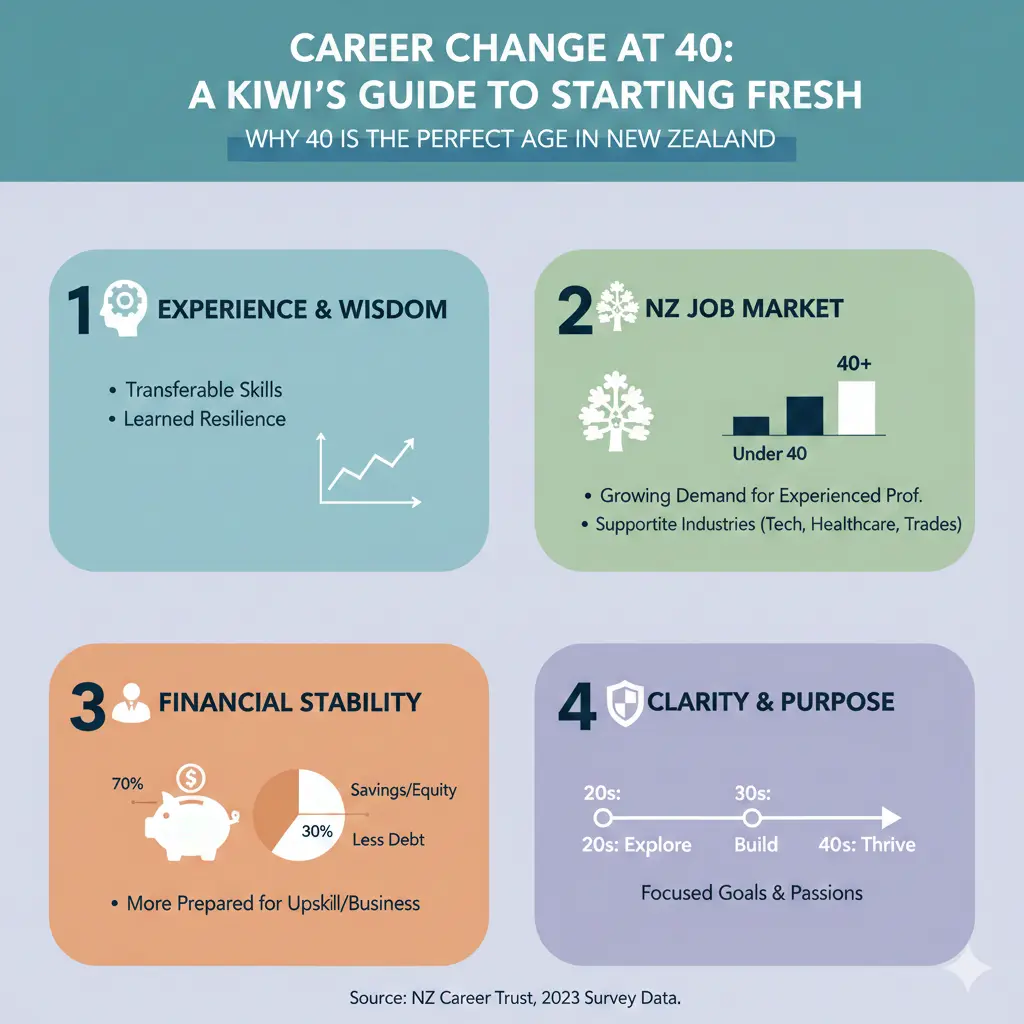
Why 40 is the Perfect Age for a Career Change in New Zealand
At 40, you've got a decade or more of real-world expertise that employers crave, especially as the labour market rebounds. New Zealand's workforce outlook for 2026 points to modest employment growth of 0.3%, with highly skilled roles in professional services, IT, management, and healthcare leading the charge. MBIE forecasts strong demand for managers and professionals, adding 27,400 highly skilled workers annually through 2026.
Cost-of-living pressures have Kiwis seeking better wages, with applications per job ad surging amid low ad volumes. Regions like Auckland and Canterbury are turning corners, with job ads ticking up in IT, logistics, and construction. Plus, 50.5% of workers report worsening work-life balance, pushing many towards fulfilling pivots.
Growing Sectors for Mid-Career Switchers
- IT and AI-related roles: Demand surges for skills in data analysis and prompt engineering, even as businesses build capabilities.
- Healthcare and technical specialists: Steady growth amid an ageing population.
- Construction and business services: Forecast to add 5,600 and 7,600 workers yearly.
- Tourism and professional services: South Island hotspots like Canterbury and Otago see 10-15% rises in listings.
These areas value maturity—your leadership from past roles can fast-track you into management or advisory positions.
Step 1: Assess Your Transferable Skills
Your career history is gold. Transferable skills like communication, problem-solving, and project management shine across industries. A career coach notes that modern resumes need "identity translation" for non-linear paths, turning retail experience into logistics prowess or teaching into training roles.
How to Identify and Showcase Them
- Self-audit: List achievements from your CV. Ask: What problems did I solve? Tools like LinkedIn's skills assessment or free Career Services workshops help.
- Kiwi examples: A former tradie moving to construction management highlights safety compliance and team leadership—hot in 2026's rebound.
- Tailor your narrative: Use STAR method (Situation, Task, Action, Result) in interviews. For instance, customer service translates to stakeholder management in finance.
Pro tip: Join networks like Women in Tech NZ or Construction Industry Training Board for sector-specific skill mapping.
Step 2: Explore Retraining and Upskilling Options
Retraining doesn't mean full degrees—short, targeted courses align with 2026's AI-driven shifts. Over 50% of employers invest in upskilling for data and comms skills.
Free and Affordable Kiwi Resources
- Fees Free: First-year tertiary study free for eligible over-40s via Te Pūkenga (until 2026 allocations). Check eligibility at feesfree.govt.nz.
- KiwiSaver Skills: Withdraw up to $10,000 for approved training without repayment if unemployed (2026 rules).
- WINZ Training Incentives: Flexi-wage subsidies cover 40-90% of wages during on-job training for roles in demand like aged care.
- StudyLink Loans: Income-contingent for diplomas in IT or healthcare; repayments via IRD once earning over $24,128 (2026 threshold).
- Short courses: Coursera's Google Data Analytics (3-6 months) or Microsoft's AI Fundamentals, recognised by NZ employers.
| Option | Cost | Duration | Best For |
|---|---|---|---|
| Fees Free | Free (year 1) | 1 year+ | Diplomas in high-demand fields |
| WINZ Flexi-wage | Subsidised | 6-52 weeks | On-the-job switches |
| Online certs (e.g., AI) | $0-$500 | 1-3 months | Quick upskill |
Auckland's recovery boosts IT training demand, while Wellington eyes policy roles post-public sector tweaks.
Step 3: Practical Job Search Strategies for 2026
With 100-200+ apps per ad in cities, stand out via networking and persistence. Job ads are 20-30% below peaks but climbing.
Actionable Tips
- Network locally: Attend Careers Expo NZ or regionals; 70% of roles fill via connections.
- Optimise Seek/Trade Me Jobs: Customise CVs with keywords like "stakeholder engagement" for ATS filters.
- Leverage ACC/IRD: Check KiwiSaver balance for training; IRD's myIR portal flags skill shortage lists.
- Regional focus: Target Canterbury for construction (less competition).
- Track applications: Spreadsheet with 10-15 weekly apps; set alerts for "mid-career" roles.
"Persistence pays—with 20,000 more roles projected, 2026 could be your year."
Overcoming Common Challenges at 40
Age bias? Flip it: Emphasise reliability—67.4% of Kiwis feel underpaid, so highlight ROI on your experience. Family commitments? Part-time retraining via WINZ fits around school runs.
Financial Safety Nets
- Jobseeker Support: Up to $336/week (single, 2026 rate) plus accommodation supplement via MyMSD.
- Redundancy: 4% KiwiSaver contribution during notice; negotiate outplacement.
- Side hustles: Freelance on Upwork while transitioning, common in Auckland's gig economy.
Real Kiwi Success Stories
Meet Sarah, 42, ex-retail manager in Wellington who retrained via Fees Free into healthcare admin amid public sector stabilising. Or Mike, 39, from manufacturing to IT support in Canterbury—WINZ Flexi-wage covered his cert, landing a role with 15% pay bump.
These stories show: With planning, 40+ changes thrive in recovering markets.
FAQ
Is 40 too late for a career change in NZ?
No—maturity is an asset in growing sectors like IT and healthcare, with 27,400 highly skilled roles needed yearly.
What funding is available for retraining?
Fees Free, KiwiSaver withdrawals, WINZ subsidies—check feesfree.govt.nz or msd.govt.nz.
How long does a career switch take?
3-12 months: 1-3 for upskilling, 2-6 for job hunt in 2026's market.
Are there age discrimination laws?
Yes, Human Rights Act 1993 prohibits it; complain via hrc.co.nz if faced.
Which regions offer best odds?
Canterbury, Otago for tourism/construction; Auckland for IT.
Do I need a full qualification?
Often not—micro-credentials suffice for 50%+ employer upskilling needs.
Your Next Steps to a Fresh Start
Grab a coffee, audit your skills today, then book a WINZ appointment or Fees Free check. Update LinkedIn, apply to 5 roles weekly, and connect with 3 contacts. In 2026's lifting market, your pivot could mean better pay, balance, and purpose—kiwisage strong!
Sources & References
-
1
New Zealand hiring market: Workforce outlook for 2026 — www.talentinternational.com
-
2
Medium to long-term employment outlook: Looking ahead to 2026 — www.mbie.govt.nz
-
3
Job Search Strategies for 2026 | Career Solutions NZ — www.careersolutions.co.nz
-
4
Mood of the Workforce 2026 - NZCTU — union.org.nz
- 5
Related Articles

Using Case Converters for Professional NZ Emails
This article references the following sources for accuracy and further reading:

Highest Paying Jobs in NZ 2026: Industries That are Desperate for Staff
If you're considering a career change or planning your next move in the New Zealand job market, you'll want to know where the money is—and more importantly, where employers are actively hiring. The go...

The Perfect NZ CV: A Free Template for 2026 Job Seekers
Your CV is your first chance to impress employers and land that job interview you're after. Whether you're a school leaver, career changer, or experienced professional, having a well-crafted CV tailor...

Best Recruitment Agencies for Tech Jobs in NZ
Searching for your next tech role in New Zealand's buzzing job market? With Kiwi tech hubs like Auckland, Wellington, and Christchurch leading the charge in cloud computing, cybersecurity, and softwar...