KiwiSaver vs Other Investments: Where Should Your Money Go?

Ever wondered if your hard-earned cash is working as hard as it could in KiwiSaver, or if there's a better spot for it elsewhere? With house prices cooling and shares hitting new highs, many Kiwis are...
Sarah covers personal finance, tax, and KiwiSaver topics for Lifetimes NZ. She focuses on making money management straightforward and practical for everyday Kiwis.
Ever wondered if your hard-earned cash is working as hard as it could in KiwiSaver, or if there's a better spot for it elsewhere? With house prices cooling and shares hitting new highs, many Kiwis are asking: KiwiSaver vs other investments: where should your money go? Let's break it down with real numbers, pros, cons, and practical tips tailored to our New Zealand landscape in 2026.
Understanding KiwiSaver: The Kiwi Retirement Staple
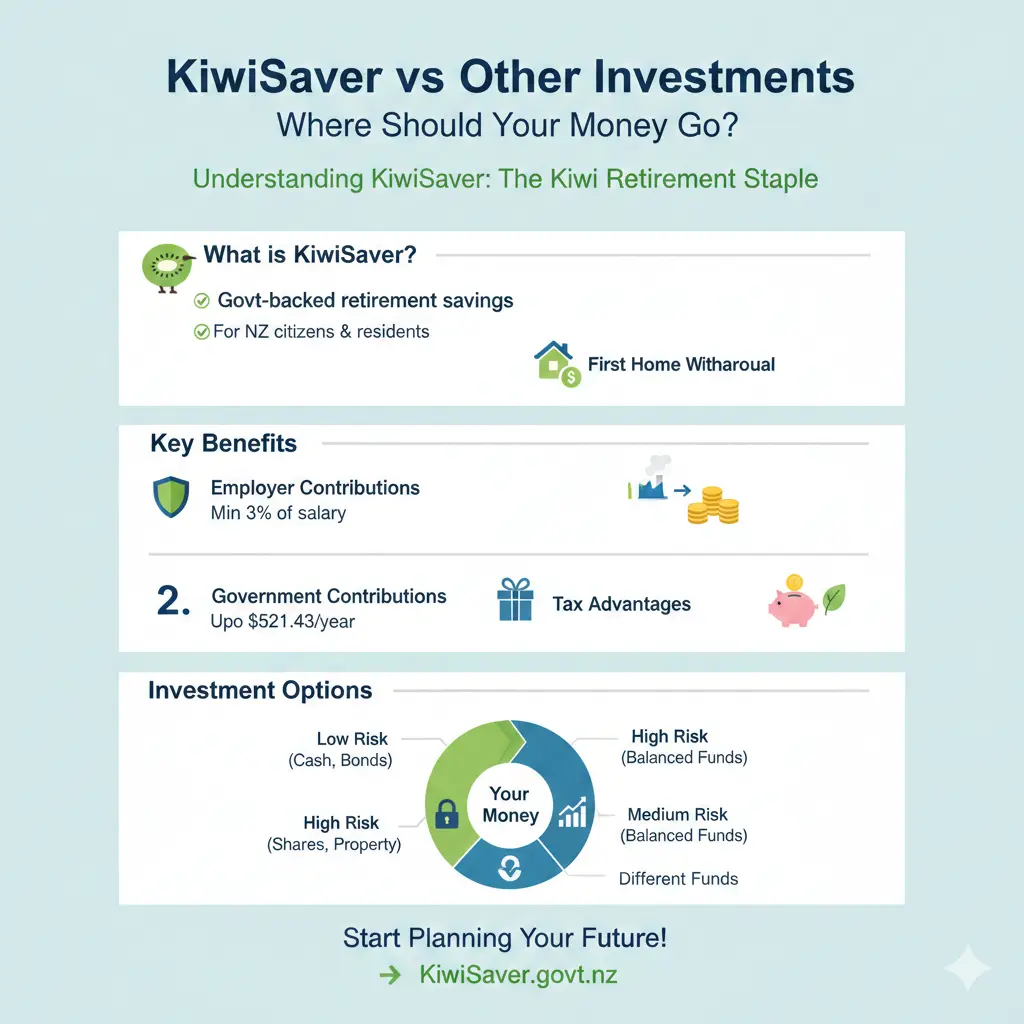
KiwiSaver remains a cornerstone for most Kiwis building towards retirement or a first home. It's a voluntary scheme where you contribute 3%, 4%, 6%, 8%, or 10% of your pay, and your employer matches at least 3% if you put in the minimum. On top of that, the government kicks in up to $521.43 annually through member tax credits, as long as you contribute at least $1,042.86 a year.
Some employers sweeten the deal further—government roles might match up to 4.5%. You pick your fund type, from conservative to aggressive, spreading your money across shares, bonds, and property for diversification without needing expertise.
Key Pros of KiwiSaver
- Free money boost: Employer and government contributions can effectively double your input.
- No upfront cash needed: Just a paycheck to start.
- Tax advantages: PIR (Prescribed Investor Rate) taxes are handled automatically, often lower than personal rates.
- Lock-in for discipline: Money stays put until 65 (or first home), helping compound growth.
The Downsides
Your funds are largely locked away—no quick access for emergencies unless hardship or terminal illness applies. Self-employed Kiwis miss the employer match, making it less appealing unless chasing the government top-up.
Top Alternative Investments in New Zealand
Beyond KiwiSaver, Kiwis have solid options like property, shares, managed funds, and more. Here's a rundown of the top performers in 2026, with real-world comparisons.
1. Residential Property: The Classic Kiwi Favourite
Property has long been our go-to, but returns are shifting. From 2015-2025, national average asking prices rose 55.1% (from $556,931 to $863,747), averaging about 4.2% annually. Auckland lagged behind expectations of doubling every decade.
Experts like University of Auckland's Gertjan Verdickt note long-term real returns (after tax and quality adjustments) hover at 2-3% yearly—solid, but outperformed by equities. Leverage via mortgages amplifies gains (or losses), unlike other assets.
2. Shares and Index Funds
The NZX50 delivered 4.92% annual price growth over the past decade (57.67% cumulative), but global shares via ETFs often beat that. Kernel Wealth's Dean Anderson highlights shares consistently outperform property long-term.
Direct shares or low-fee index funds offer liquidity and diversification. No lock-in, and you control your picks—ideal alongside KiwiSaver.
3. Managed Funds (Non-KiwiSaver)
These pool money like KiwiSaver but without restrictions. Fund managers diversify across shares, bonds, and property; you access withdrawals easily. Fees apply (watch those!), but they're lower entry than direct property.
Great for hands-off investors wanting global exposure without KiwiSaver's lock-up.
4. Other Options: ETFs, Bitcoin, Gold
- ETFs: Track indices cheaply; blend with KiwiSaver for global diversification.
- Bitcoin: Exploded 50,000% in the past decade—high risk, high reward.
- Gold: Up over 270% recently, as an inflation hedge.
KiwiSaver vs Other Investments: Head-to-Head Comparison
To decide where your money should go, compare returns, risks, and fit. Over the last 10 years to 2025, aggressive KiwiSaver funds averaged 9.7% annually (150% cumulative)—beating housing's 55%. KiwiSaver's edge? Employer/government boosts.
| Investment | Avg. Annual Return (Past 10 Yrs) | Liquidity | Min. Investment | Risk Level |
|---|---|---|---|---|
| KiwiSaver (Aggressive) | 9.7% | Low (locked till 65) | $0 (paycheck-based) | Medium-High |
| Residential Property | ~4.2% | Medium (sell time) | 20% deposit (~$170k) | Medium (leverage) |
| NZX50 Shares | 4.92% | High | $500+ | High |
| Managed Funds | Varies (similar to KS) | High | $1,000+ | Medium |
Property shines with leverage, but downturns hurt. Shares/KiwiSaver offer better diversification and historical edges. In 2026, with baby boomers selling rentals, property supply rises—potentially pressuring prices.
2026 Updates: What's Changing for Kiwi Investors?
KiwiSaver default contributions rise 0.5% this year, then again in two years, boosting household savings. Funds like Pie KiwiSaver's aggressive options stand out for active management and global equities. Watch debt levels and cooling economies pushing bond yields higher.
For long-term strategies, blend KiwiSaver with global shares for compound growth and tax perks.
Practical Tips: Where Should Your Money Go?
Match investments to your goals, age, and risk tolerance:
- Max KiwiSaver first: Grab employer match and gov contribution—it's free money. Switch to growth/aggressive if under 50.
- Build an emergency fund: 3-6 months' expenses in a high-interest saver before extras.
- Diversify beyond KS: Add shares/ETFs via Sharesies or Hatch for liquidity. Aim 50-70% equities long-term.
- Property? Only if you can afford 20-40% deposit without selling KiwiSaver. Consider REITs for exposure without full buy-in.
- Review annually: Check fees (under 0.5% ideal), performance via Sorted.org.nz, and adjust.
- Self-employed? Use managed funds or direct shares over KiwiSaver.
Use tools like Sorted's investor questionnaire or MoneyHub's fund picks.
Next Steps for Smarter Investing
Don't park everything in one basket. Start by logging into your KiwiSaver dashboard—boost contributions if possible, and review your fund mix. Open a Sharesies or Hatch account for side investments, and chat with a Sorted-approved adviser via Financial Advice NZ. Track via the Financial Markets Authority's register. Your future self (and wallet) will thank you—get started today for that 2026 growth edge.
Frequently Asked Questions
Sources & References
-
1
Top 8 Best Investments in New Zealand (2026) | Opes Partners — www.opespartners.co.nz
-
2
KiwiSaver vs other managed funds - Sorted Smart Investor — smartinvestor.sorted.org.nz
- 3
-
4
Our Favourite KiwiSaver Funds - MoneyHub NZ — www.moneyhub.co.nz
-
5
Best Long-Term Investment Strategies in 2026 - Compound Wealth — www.compoundwealth.co.nz
-
6
Backing ambition, building growth | Beehive.govt.nz — www.beehive.govt.nz
-
7
Kia Ora Magazine: Investing: six things to watch in 2026 - Pie Funds — www.piefunds.co.nz
-
8
Stocks, Inflation & Kiwisaver w Greg Smith of Generate - YouTube — www.youtube.com
-
9
Should I be investing in something other than KiwiSaver? - BNZ — www.bnz.co.nz
Related Articles

KiwiSaver 2026: Which Fund is Actually Winning the Performance Race?
If you're tracking your KiwiSaver fund performance in 2026, you might be surprised to learn that the winners aren't always the biggest banks – and the rankings keep shifting. The latest investment sur...

PIR Rates Explained: Are You Paying Too Much Tax on Your KiwiSaver?
Ever checked your KiwiSaver statement and wondered why the tax on your returns seems off? You're not alone—many Kiwis are paying too much (or too little) on their KiwiSaver earnings because of an inco...

Best KiwiSaver Providers in NZ 2025: Complete Comparison
Choosing the right KiwiSaver provider can supercharge your retirement savings or first home deposit, especially with government contributions and employer matches adding free money to your account. In...

How to Choose the Right KiwiSaver Fund for Your Age
Choosing the right KiwiSaver fund is one of the most important financial decisions you'll make for your retirement. Your age, time horizon, and risk tolerance should guide your choice, but with 370 fu...