Settlement Day NZ: What Happens and What to Prepare

Imagine the thrill of finally holding the keys to your new Kiwi home after months of house hunting, finance approvals, and paperwork. But as settlement day approaches, that excitement can mix with ner...
Sarah covers personal finance, tax, and KiwiSaver topics for Lifetimes NZ. She focuses on making money management straightforward and practical for everyday Kiwis.
Imagine the thrill of finally holding the keys to your new Kiwi home after months of house hunting, finance approvals, and paperwork. But as settlement day approaches, that excitement can mix with nerves—what exactly happens, and how can you ensure everything goes smoothly? Settlement Day NZ is the pivotal moment when ownership transfers, funds swap hands, and you take possession, but delays or hiccups can turn it stressful. This guide breaks down what happens on Settlement Day NZ and what to prepare, with practical tips tailored for Kiwis buying their first home or upgrading.
What is Settlement Day in New Zealand?
Settlement Day, often called 'going unconditional' finalisation, is when you pay the full purchase price (or balance after deposit) and legally become the property owner. Your lawyer or conveyancer handles the process, coordinating with the seller's side and your lender. Typically set 20-90 days after the sale goes unconditional, it's governed by the standard ADLS/REINZ Agreement for Sale and Purchase.
In 2026, with steady property market activity and updated lending rules from the Reserve Bank, settlements remain electronic via the Electronic Transactions Act, making funds transfer swift but still prone to timing issues.
Why Settlement Day Matters for Buyers
It's not just paperwork—it's when risks shift. Pre-settlement, the seller handles insurance and maintenance; post-settlement, that's on you. KiwiSaver withdrawals, HomeStart grants, and lender funds all converge here, so preparation avoids penalty interest under AML rules.
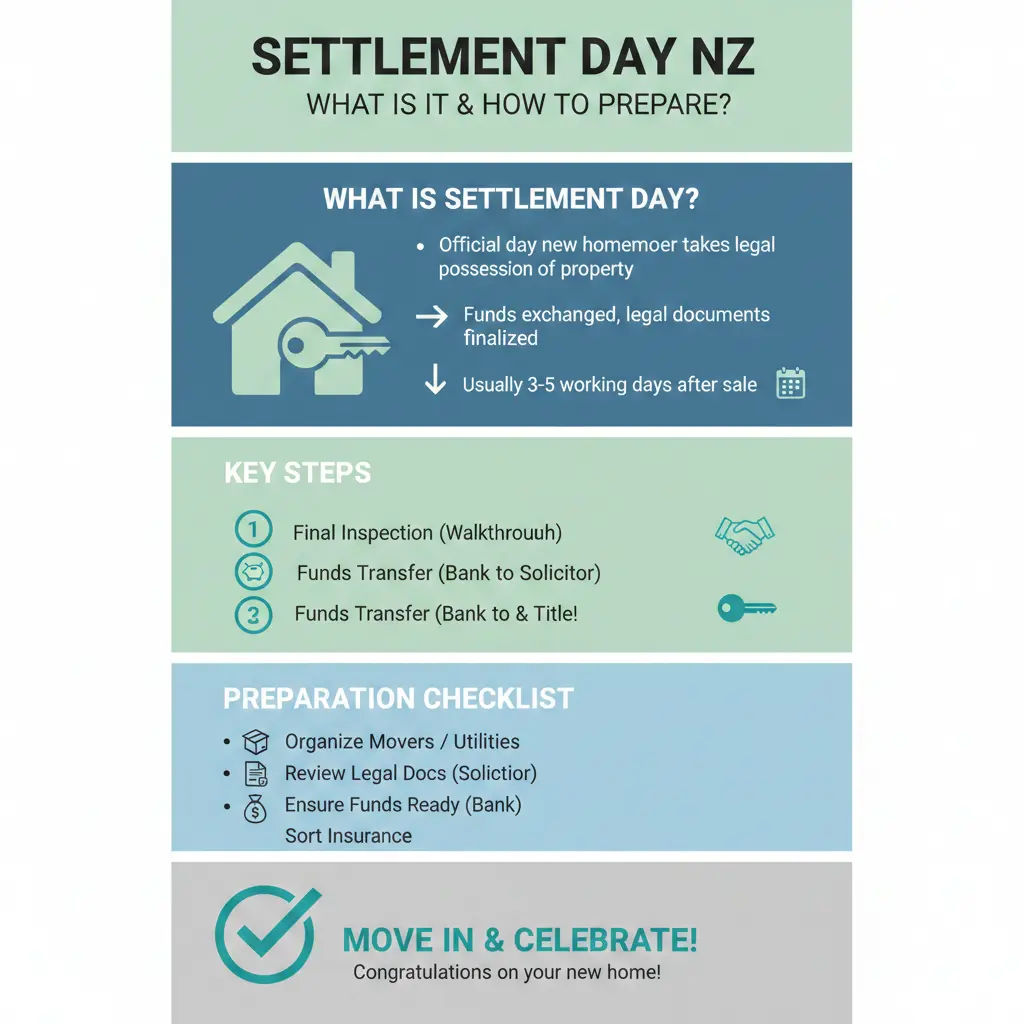
The Step-by-Step Process: What Happens on Settlement Day NZ
Your role is minimal if docs are signed early, but understanding the sequence helps manage expectations. Here's what unfolds, usually between 9am and 4:30pm.
Step 1: Funds Transfer from Your Side
Your bank (e.g., Westpac, ANZ) sends the loan balance to your solicitor's trust account by morning. Add your deposit, KiwiSaver withdrawal (up to $50,000+partner for first-home buyers via Kāinga Ora), and any First Home Grant (up to $10,000 in 2026).
- Your solicitor confirms funds: lender loan + your equity + grants.
- They issue an 'undertaking' to pay the vendor once title transfers.
Step 2: Vendor's Mortgage Discharge
The seller's bank provides a final payout figure (including interest to settlement date). Their solicitor discharges the mortgage via Land Information New Zealand (LINZ), a process that can take hours.
Pro tip: Chains of settlements (you're selling and buying) extend this—plan for delays.
Step 3: Payment and Title Transfer
Your solicitor transfers funds to the vendor's solicitor, who confirms receipt and releases the title. LINZ updates the Record of Title with your name and mortgagee details. This electronic lodgement is instant but awaits undertakings.
"Property settlement is like a chain, and any broken links may delay the keys."
Step 4: Key Handover and Possession
Once confirmed (often 3pm, latest 4:30pm), your solicitor notifies you. Collect keys from the real estate agent or solicitor. You're now in—change locks immediately for security.
Common Delays on Settlement Day and How to Handle Them
Delays happen in 20-30% of settlements due to chains, final inspections, or vendor issues. Penalty interest accrues at contract rates (often 12-15% p.a.) if you're late.
| Common Issue | Cause | Solution |
|---|---|---|
| Funds not cleared | Bank delays or AML checks | Send funds 48 hours early; use CHATS system. |
| Vendor mortgage payout | Late bank confirmation | Your lawyer chases; common in mornings. |
| Final inspection fails | Damage or unclean property | Negotiate repairs or price holdback via lawyers. |
| Settlement chain | Linked sales | Book movers for next day. |
If overseas buyers (needing OIO consent), add 183-day residency proof post-settlement, but that's post-2026 reforms easing for residents.
What to Prepare Before Settlement Day NZ
Start 2-4 weeks out. Your lawyer manages most, but your prep prevents stress.
Financial Preparations
- Confirm KiwiSaver withdrawal with provider (e.g., ASB, ANZ)—needs First Home Withdrawal form to IRD.
- Secure HomeStart Grant via Kāinga Ora—$5k-$10k based on location/equity (2026 rates).
- Deposit equity into solicitor's trust 48 hours prior—avoid weekends/public holidays like Matariki.
- Notify IRD of address change for tax/IRD numbers post-settlement.
Property and Legal Checks
- Final inspection (1-2 days prior): Check repairs, water meter reading, chattels (oven, blinds).
- Building/healthy homes compliance: Ensure Healthy Homes Standards met (2026 updates emphasise ventilation).
- Insurance: Buyer’s risk from possession—activate home insurance day-of.
- Rates: Inform lawyer of invoice preference (email/mail); vendor handles final water reading.
Logistics and Moving Prep
Create a checklist:
- Book movers for next day to buffer delays.
- Arrange childcare/pets—settlement's busy.
- Utilities: Contact Vector/Powerco for electricity, Wellington Water for rates transfer.
- Packing: Label boxes; update NZ Post mail redirect.
- Keys: Get spares cut; notify neighbours.
For first-home buyers, check StudyLink if studying or WINZ for relocations, but finance is key via KiwiSaver.
Costs Involved on Settlement Day NZ (2026 Rates)
Beyond purchase price:
- Lawyer fees: $1,500-$3,000.
- LINZ/Title fees: ~$200.
- Rates adjustment: Prorated to settlement.
- No stamp duty, but bright-line test applies for tax (2-10 years holding).
- AML checks: Free but document source of funds.
Total add-ons: 1-2% of price. Budget via mortgage calculator on bank sites.
Special Considerations for First-Home Buyers and Overseas Kiwis
First-homers: Maximise KiwiSaver/HomeStart—2026 caps unchanged, but eligibility tightened for multiples. Overseas: OIO consent if non-resident; must live in within 3 months, 183 days/year.
FAQ: Settlement Day NZ Questions
What time do I get the keys on settlement day?
Usually by 3pm, but up to 4:30pm or next day if delayed. Plan movers accordingly.
What if settlement is delayed?
Lawyers negotiate; you may pay vendor holding costs. Penalty interest if your fault.
Do I need to be present?
No—lawyer handles; just ensure funds ready.
What docs do I sign before?
Authority to pay 2-3 days prior; Residential Land Statement if overseas-eligible.
Who pays rates post-settlement?
You, from water reading date. Vendor adjusts at settlement.
Can I back out on the day?
No—unconditional contract binds; only via lawyer disputes.
Next Steps After a Smooth Settlement
Congrats—update your address with IRD, ACC, electoral roll, and banks. Change locks, set up utilities, and enjoy! Monitor KiwiSaver contributions for tax credits. For finance tweaks, consult a adviser. Disclaimer: This is general info; seek personalised advice from your lawyer, bank, or financial adviser for your situation.
Armed with this, your Settlement Day NZ will be stress-free. Share your story in comments!
Sources & References
-
1
The Settlement Process When Buying a Home - Prosperity Finance — prosperityfinance.co.nz
-
2
Settling on settlement day when buying - Settled.govt.nz — www.settled.govt.nz
-
3
Settlement day made easy | Westpac NZ — www.westpac.co.nz
-
4
What happens on settlement day? - Property - Trade Me — www.trademe.co.nz
-
5
Buying residential property to live in | Overseas investment Guidance — www.linz.govt.nz
-
6
Buying property in New Zealand in 2026 - Smart Currency Exchange — www.smartcurrencyexchange.com
- 7
-
8
5 things you can do to help prevent stress on settlement day — martellimckegg.co.nz
Related Articles

Industry Bodies and Professional Associations NZ
Whether you're launching a business, advancing your career, or navigating financial regulations, industry bodies and professional associations in New Zealand offer invaluable support. These organisati...

Emergency Benefit NZ: When You Have No Other Options
When you're struggling financially and don't qualify for other benefits, the Emergency Benefit might be your lifeline. It's a discretionary payment designed for Kiwis in genuine hardship who've exhaus...

Unpaid Internships NZ: Are They Legal?
Unpaid internships are a common pathway for students and graduates to gain work experience in New Zealand, but there's often confusion about whether they're actually legal. The short answer is: unpaid...

Estate Administration NZ: Managing Someone's Affairs After Death
Losing a loved one is one of life's toughest challenges, and stepping in to manage their estate can feel overwhelming. In New Zealand, estate administration—the process of handling someone's affairs a...