Working From Home Tax Deductions NZ

Imagine slashing hundreds of dollars off your tax bill simply by working from your Kiwi home office. With hybrid work here to stay, more New Zealanders are discovering the power of working from home t...
Sarah covers personal finance, tax, and KiwiSaver topics for Lifetimes NZ. She focuses on making money management straightforward and practical for everyday Kiwis.
Imagine slashing hundreds of dollars off your tax bill simply by working from your Kiwi home office. With hybrid work here to stay, more New Zealanders are discovering the power of working from home tax deductions NZ—legitimate claims that reward your setup and setup costs.
Whether you're a sole trader juggling family life in Auckland or a freelancer in Dunedin, understanding IRD rules can unlock real savings. This guide breaks down everything you need to claim in 2026, from square metre rates to full calculations, with practical tips tailored for Kiwis.
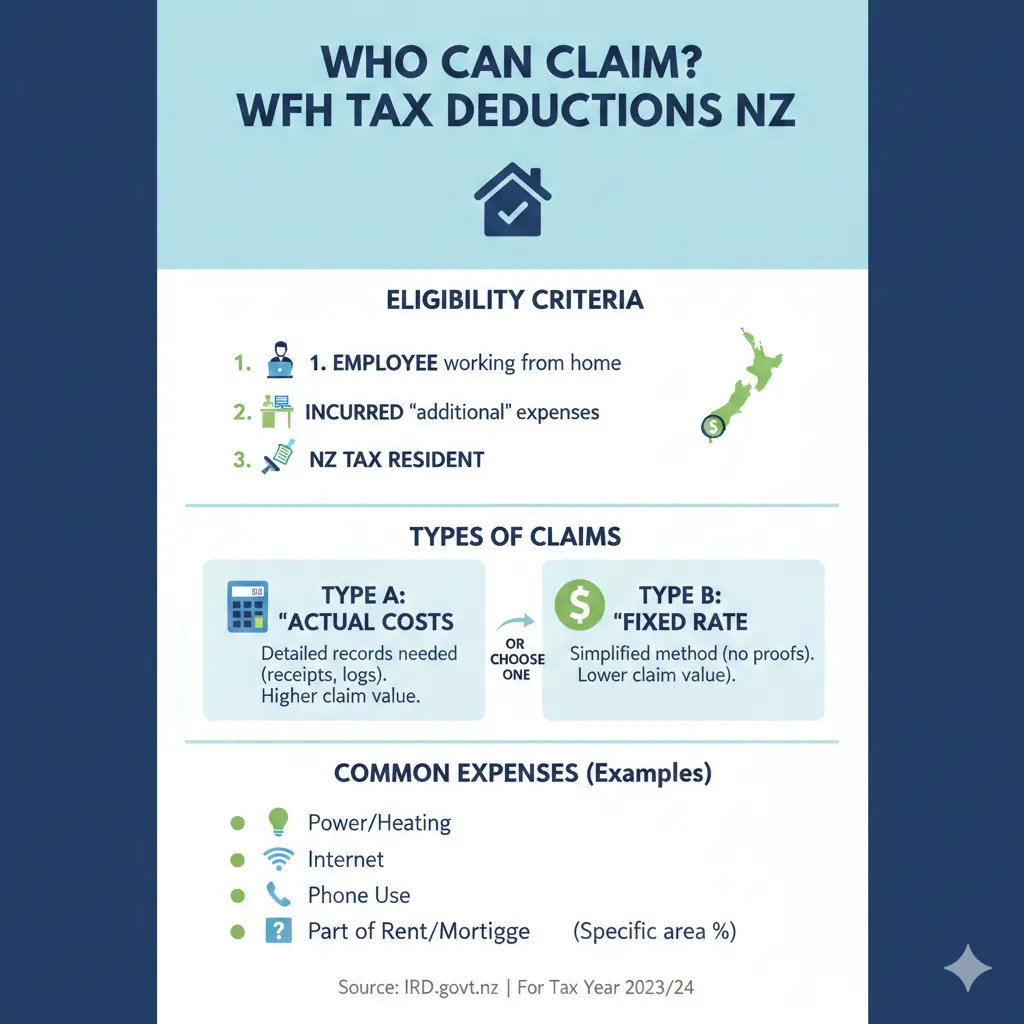
Who Can Claim Working From Home Tax Deductions in New Zealand?
Not everyone qualifies for working from home tax deductions NZ. Primarily, self-employed folks—sole traders, partnerships, or company owners—can claim if they use part of their home to generate business income.
Employees face stricter limits. Your employer might reimburse home office costs, but they aren't required to. If they do, it's often tax-free for you, but you can't double-dip by claiming personally.
Key Eligibility Criteria
- Your home space must be used regularly for business, like a dedicated office or workspace.
- You need records proving business use, such as diaries, floor plans, or photos.
- Incidental use (e.g., occasional emails from the couch) doesn't count—aim for a fixed area.
Pro tip: If you're renting or own your home, both setups allow claims, but occupancy costs like rent or mortgage interest have special rules.
What Expenses Can You Claim?
Common household bills transform into tax savers when tied to your business space. Here's what Kiwis can claim in 2026.
Utilities: Power, Gas, Water, Internet, and Phone
Claim a portion based on your office's floor area percentage. For example, a 10m² office in a 100m² home lets you claim 10% of bills.
Phone lines get a shortcut: deduct 50% of a landline if it's shared business-private. Internet and mobile? Apportion based on business usage logs.
Occupancy Costs: Rent, Rates, Mortgage Interest
Self-employed renters or owners can claim a slice of rent, council rates, or mortgage interest (not principal). Use your work area's percentage—no claiming the whole house!
Watch out: Using the square metre rate excludes these, so calculate separately.
Office Gear and Furniture
- Items under $1,000 (GST-exclusive for GST-registered): 100% immediate write-off.
- Over $1,000: Depreciate over time, but grab the new 20% Investment Boost on assets bought from 22 May 2025.
- Stationery, ink, keyboards: Fully deductible if business-only.
Insurance and Other Costs
Portion of house/contents insurance, plus ACC levies if relevant. Software subscriptions like Xero or cloud tools count too.
| Expense Type | Claim Method | Example for 10m² Office (10% of Home) |
|---|---|---|
| Electricity Bill ($2,000/year) | Percentage | $200 |
| Rent ($500/week) | Percentage | $2,600/year |
| Desk ($800) | Immediate Write-off | $800 full |
| Internet ($100/month) | Usage Log or Percentage | $120/year (10%) |
How to Calculate Your Deductions: Two IRD-Approved Methods
IRD offers two paths for working from home tax deductions NZ: simple square metre or detailed actual costs. Pick what suits your records.
Method 1: Square Metre Rate (Easiest for 2026)
This fixed rate covers utilities, insurance, and phone—but skips rent, rates, mortgage interest. For 2024/25, it's $55.60 per m²; expect the 2025/26 rate in May 2026 from IRD.
Example: 12m² office = 12 x $55.60 = $667.20 (2024/25 rate). Add separate occupancy claims.
Method 2: Actual Cost (Maximise Savings)
Calculate each expense's business portion. Measure floor area, divide by total home size.
GST tip: Apportion both GST and net amounts. E.g., $250 power bill (GST $32.61, net $217.39), 10% business = $3.26 GST + $21.74 income tax claim.
Formula: (Office m² / Total home m²) x Total expense = Claimable amount.
Depreciation and Low-Value Assets
Furniture over $1,000? Depreciate at standard rates, boosted 20% upfront for new 2025 buys. Computers, chairs under threshold: instant deduction.
Step-by-Step: How to Claim on Your 2026 Tax Return
- Measure your space: Sketch floor plan, calculate percentage.
- Gather receipts: Bills, invoices for 12 months (April-March GST period).
- Log usage: Diary of business hours/days to justify claims.
- Choose method: Square metre or actual—run both for max.
- File via myIR: Enter in income tax return; GST-registered claim input tax too.
- Deadlines: Provisional tax by instalments; terminal by 9 February 2026 (underpayment interest 8.97%).
Pro tip: Use apps like Solo for tracking—snap receipts, auto-categorise. Always keep records for 7 years; IRD audits are real.
2026 Tax Rates and Thresholds for Self-Employed Kiwis
Your deductions lower taxable income, taxed progressively.
| Income Range | Tax Rate |
|---|---|
| $0 – $15,600 | 10.5% |
| $15,601 – $53,500 | 17.5% |
| $53,501 – $78,100 | 30% |
| $78,101 – $180,000 | 33% |
| Over $180,000 | 39% |
Disclaimer: Tax rules change—consult IRD's calculator or a tax advisor for your situation. This isn't personalised advice.
Common Pitfalls and How to Avoid Them
- Over-claiming: Don't exceed actual business use; IRD denies excessive portions.
- No records: Photos, bills, logs essential—digital folders work best.
- Employees: Check employer policy first; personal claims rare.
- GST errors: Claim only business portion on both GST/net.
For digital nomads: From 1 April 2026, non-residents working remotely for offshore bosses may dodge NZ tax under new rules.
Max Your Savings: Next Steps for Kiwis
Start today: Measure your office, tally 2026 bills, and test both calculation methods. Tools like MYOB or Xero simplify tracking.
Chat with an accountant or use IRD's free resources—your wallet (and sanity) will thank you. Remember, deductions lower taxable income across brackets, potentially saving thousands. Track diligently, claim confidently, and keep more Kiwi dollars working for you.
Seek professional advice for your circumstances. Tax laws evolve—verify with IRD.
Frequently Asked Questions
Sources & References
-
1
Calculating working from home tax deductions - MYOB — www.myob.com
- 2
- 3
-
4
Tax proposal clears the way for digital nomads - Simpson Grierson — www.simpsongrierson.com
-
5
Claiming home office expenses NZ - The complete guide - Solo NZ — www.soloapp.nz
-
6
Home office expenses - Inland Revenue — www.ird.govt.nz
- 7
-
8
Confirmed: Tax Rule Change Starts From 1 July 2026 — www.outdoorshadesolutions.co.nz
-
9
Confirmed: Tax Rule Change Starts From 1 July 2026 - ArtBeat NZ — www.artbeat.org.nz
-
10
Claiming expenses - business.govt.nz — www.business.govt.nz
Related Articles

Industry Bodies and Professional Associations NZ
Whether you're launching a business, advancing your career, or navigating financial regulations, industry bodies and professional associations in New Zealand offer invaluable support. These organisati...

Emergency Benefit NZ: When You Have No Other Options
When you're struggling financially and don't qualify for other benefits, the Emergency Benefit might be your lifeline. It's a discretionary payment designed for Kiwis in genuine hardship who've exhaus...

Unpaid Internships NZ: Are They Legal?
Unpaid internships are a common pathway for students and graduates to gain work experience in New Zealand, but there's often confusion about whether they're actually legal. The short answer is: unpaid...

Estate Administration NZ: Managing Someone's Affairs After Death
Losing a loved one is one of life's toughest challenges, and stepping in to manage their estate can feel overwhelming. In New Zealand, estate administration—the process of handling someone's affairs a...