Tax Deductions and Expenses: What Can You Claim?
Getting your tax deductions right can save you hundreds or even thousands of dollars each year. Whether you're self-employed, running a small business, or investing in rental property, understanding w...
The Lifetimes NZ editorial team curates, fact-checks, and updates guides on personal finance, property, health, immigration, legal, business, and lifestyle topics relevant to Lifetimes NZ readers. Articles are produced with AI assistance and reviewed by the editorial team before publication.
Getting your tax deductions right can save you hundreds or even thousands of dollars each year. Whether you're self-employed, running a small business, or investing in rental property, understanding what you can claim is essential to reducing your tax bill. The good news? There's a lot more you can deduct than many Kiwis realise.
Understanding Tax Deductions in New Zealand
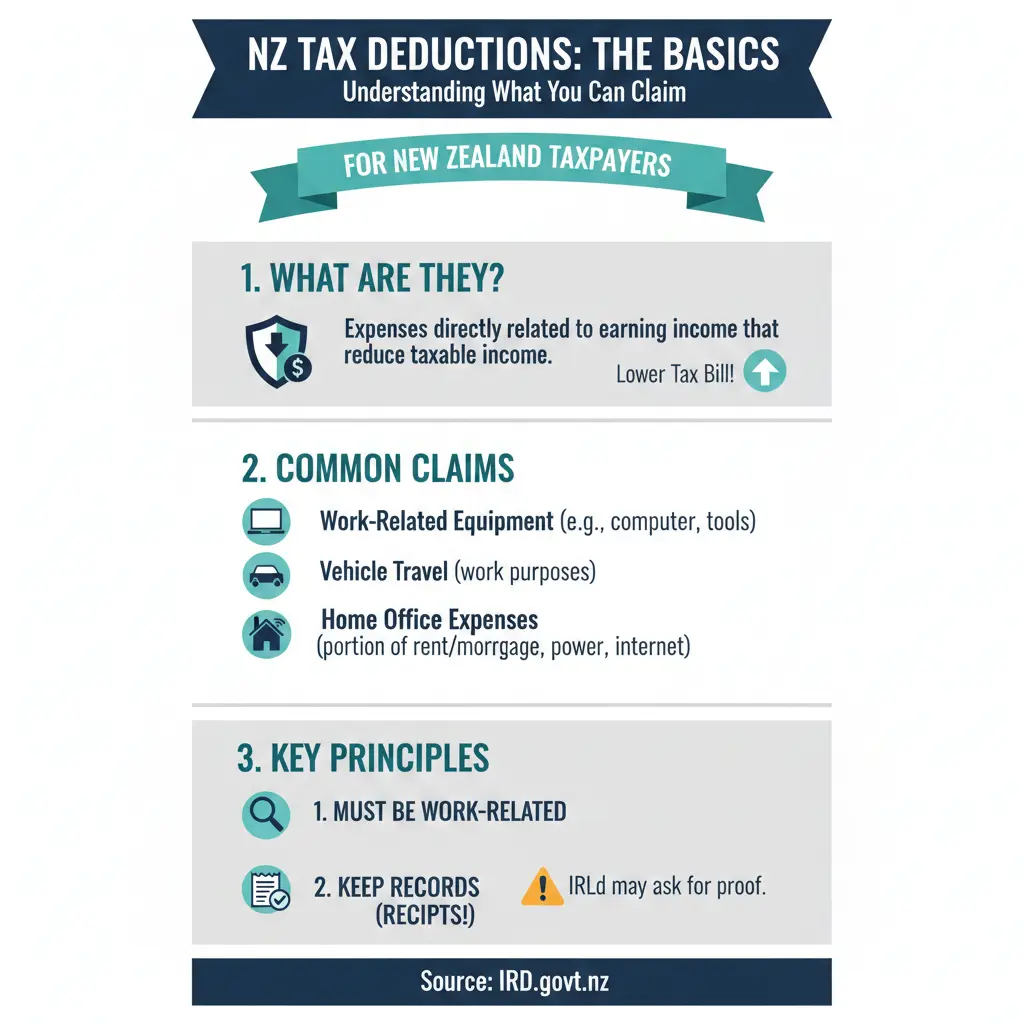
A tax deduction reduces the amount of income you pay tax on. For example, if your business earns $80,000 in a year but you have $20,000 in deductible expenses, you'll only pay tax on $60,000. This can result in significant savings, especially when you're in a higher tax bracket.
The Inland Revenue Department (IRD) has clear rules about what you can and can't claim. To be deductible, an expense must be:
- Directly related to earning income – It must be a genuine business cost, not personal spending
- Properly documented – Keep receipts, invoices, and records in case IRD requests proof
- Claimed correctly – If an expense is partly for business and partly personal, you can only claim the business portion
For expenses that are partly business and partly personal, you can only claim the proportion that relates to your business. For instance, if you use your mobile phone 70% for work and 30% for personal use, you can only claim 70% of the bill.
Business Operating Expenses You Can Claim
If you're running a business or are self-employed, several everyday operating costs are tax-deductible:
- Rent or lease costs for business premises
- Utilities (electricity, water, internet, phone)
- Office supplies (stationery, printing costs, software subscriptions)
- Business insurance (public liability, professional indemnity, contents insurance)
- Work uniforms and protective clothing
- Professional association memberships
- Work-related journals and magazines
- Tax agent's fees
The key is that these must be genuine business costs. You can claim 100% of expenses that are solely for business purposes, but for mixed-use expenses, you'll need to calculate the business portion.
Vehicle and Travel Expenses
If you use a vehicle for business purposes, several costs are deductible:
- Fuel and maintenance costs
- Registration and insurance
- Depreciation (if you own the vehicle)
- Lease payments (if you lease a business vehicle)
If you use your vehicle for both business and personal use, you can only deduct the business portion. The logbook method is a common way to track mileage for business trips. Keep detailed records of your business journeys to support your claim.
For business-related travel, you may also be able to deduct:
- Domestic and international flights
- Accommodation costs
- Rental car hire
- Business-related meals (note: some meals may only be 50% deductible under NZ tax rules)
Equipment, Tools, and Assets
How you claim equipment and tools depends on the cost of the asset:
- Under $1,000: You can claim the full amount immediately as an expense
- Over $1,000: You must depreciate the cost over time
This means for a $500 laptop, you'd claim the full amount in that tax year. For a $2,000 office desk, you'd depreciate it over several years. Check IRD's depreciation rates to ensure you're claiming these deductions correctly.
Employee Wages and KiwiSaver Contributions
If you have employees, you can deduct:
- Salaries and wages paid to staff
- Compulsory KiwiSaver employer contributions (minimum 3%)
- ACC levies paid on behalf of employees
- Payments to contractors (if they're genuinely independent contractors under IRD rules)
Home Office Deductions
If you run your business from home, you may be able to claim a portion of household expenses related to your workspace. You can claim 100% of expenses that are solely for business purposes, such as a dedicated business phone line. For other expenses, you can claim the proportion of your house that you use for work.
Claimable home office expenses include:
- Power and gas
- Internet and phone
- Mortgage interest or rent
- Office furniture and equipment
- Home and contents insurance (proportional)
Calculating Your Home Office Deduction
There are two main ways to calculate your home office deduction. You can use the IRD's fixed square metre rate, which simplifies your claim. The IRD square metre rate for the 2024/25 income year is $55.60 per square metre. This rate covers costs like electricity, gas, internet, and home and contents insurance. It does not include rent, mortgage interest, or council rates — these must be calculated separately based on the portion of your home used for business.
Example: If your home office is 10m², your total claim using the square metre rate would be:
10 × $55.60 = $556.00
Alternatively, you can calculate your actual expenses and claim the business portion. For example, if your house is 100 square metres and your office is 10 square metres, you can claim 10% of expenses not solely for business, such as your power bill.
Remember to keep records of your home office usage to support your claim.
Interest and Banking Fees
You can deduct interest on business loans, overdrafts, and credit cards, as well as fees related to:
- Business bank accounts
- Loan establishment fees
- Merchant service fees (e.g., credit card processing costs)
Make sure any loan is strictly for business purposes — personal loans used for business may not be fully deductible.
Entertainment Expenses
Entertainment expenditure is generally 50% deductible as it's considered to provide a private element. Common examples include social work gatherings and client entertainment events.
However, certain categories of entertainment expenditure are 100% deductible:
- Light refreshments, food or drink provided at conferences
- Food or drink provided while travelling for business
- Entertainment expenditure incurred overseas
Rental Property Deductions
If you're a property investor, the rules for deducting rental expenses have changed. From 1 April 2019, deductions for expenditure incurred in relation to residential rental properties are limited to the extent of the residential income derived. Any excess expenditure is 'ring-fenced' and available to carry forward to offset against future residential rental income but generally will not be available to offset against other income streams.
However, there's good news for mortgage interest. Property investors can now deduct 100% of their mortgage interest from rental income, just like before Labour's 2021 rule change.
What Different Workers Can Claim
Self-Employed and Sole Traders
As a sole trader, you can claim business expenses for costs incurred in relation to your work. This includes all the operating expenses, vehicle costs, and home office expenses mentioned above.
You can also claim tax deductions for specific items like:
- Commission charged on earning interest or dividends
- Tax preparation fees
- Certain income protection insurance premiums
- Interest on money borrowed for investment that produces taxable income
PAYE Employees
If you're a PAYE employee, your deduction options are more limited than self-employed workers. However, you can still claim:
- Work-related mobile phones and phone bills (business portion only)
- Work uniforms and protective clothing
- Professional association memberships
- Work-related journals and magazines
- Tax agent's fees
- Home office expenses (if you work from home for your employer)
Cost of Goods Sold
If you produce or sell products, any costs incurred in order to create or produce your products or services are entirely tax deductible. This includes raw materials, packaging, and labour costs directly related to production.
Record-Keeping: Your Essential Safeguard
Proper documentation is crucial. Keep receipts, invoices, and records for all expenses you claim. If IRD requests proof, you'll need to demonstrate that your expenses are legitimate business costs. This is especially important for mixed-use expenses like home office costs or vehicle expenses, where you'll need to show how you calculated the business portion.
Consider using accounting software to track expenses and maintain organised records. This can help you maximise deductions and avoid costly mistakes.
Tax Rates and Savings
Understanding how tax brackets work can help you see the real value of deductions. There are five PAYE tax brackets for the 2025-2026 tax year:
- 10.50% on income up to $15,600
- 17.50% on income from $15,601 to $42,300
- 30% on income from $42,301 to $80,000
- 33% on income from $80,001 to $180,000
- 39% on income over $180,000
The higher your tax bracket, the greater your savings from claiming deductions. For example, if you're in the 33% tax bracket and claim $1,000 in deductions, you'll save $330 in tax.
Getting Professional Advice
Tax rules can be complex, especially if you're self-employed or have multiple income streams. Consider consulting with a tax accountant or using a tax preparation service. They can help you identify deductions you might have missed and ensure you're complying with IRD requirements.
The cost of professional advice often pays for itself through the deductions they help you claim.
Next Steps
Start by gathering all your business receipts and expenses for the current tax year. Organise them by category — operating expenses, vehicle costs, home office, etc. Then, review this guide to identify which expenses you can claim. If you're unsure about any deductions, visit the IRD website or speak with a tax professional.
Remember, the key to maximising your tax deductions is keeping good records and understanding IRD's rules. The effort you put in now could save you hundreds of dollars when you file your tax return.
Frequently Asked Questions
Sources & References
-
1
Small business tax deductions NZ: What expenses can you claim in 2025 — www.prospa.co.nz
-
2
New Zealand - Corporate - Deductions - Worldwide Tax Summaries — taxsummaries.pwc.com
-
3
Claiming expenses — www.business.govt.nz
-
4
The sole trader's guide to expenses — hnry.co.nz
-
5
Types of individual expenses — www.ird.govt.nz
-
6
New Zealand PAYE Tax Rates 2025 & 2026 — www.moneyhub.co.nz
-
7
Interest Deductibility in NZ: 2026 Tax Rules — www.opespartners.co.nz
Related Articles

Small Business Tax Guide: What NZ Freelancers Need to Know
Freelancing in New Zealand offers the freedom to be your own boss, but it comes with the responsibility of handling your own taxes. Whether you're a graphic designer in Auckland, a consultant in Welli...

Tax Refund Secrets: How to Claim Every Dollar from the IRD This Year
Ever felt like the IRD owes you money but you're not sure how to get it back? You're not alone—many Kiwis leave hundreds of dollars on the table each year simply because they don't know the tax refund...

Best Accountant for NZ Property Investors
Owning rental properties in New Zealand can build serious wealth, but navigating the tax rules often feels like a minefield. The right accountant doesn't just file your returns—they spot deductions, s...
NZ Tax System Basics: PAYE GST and More
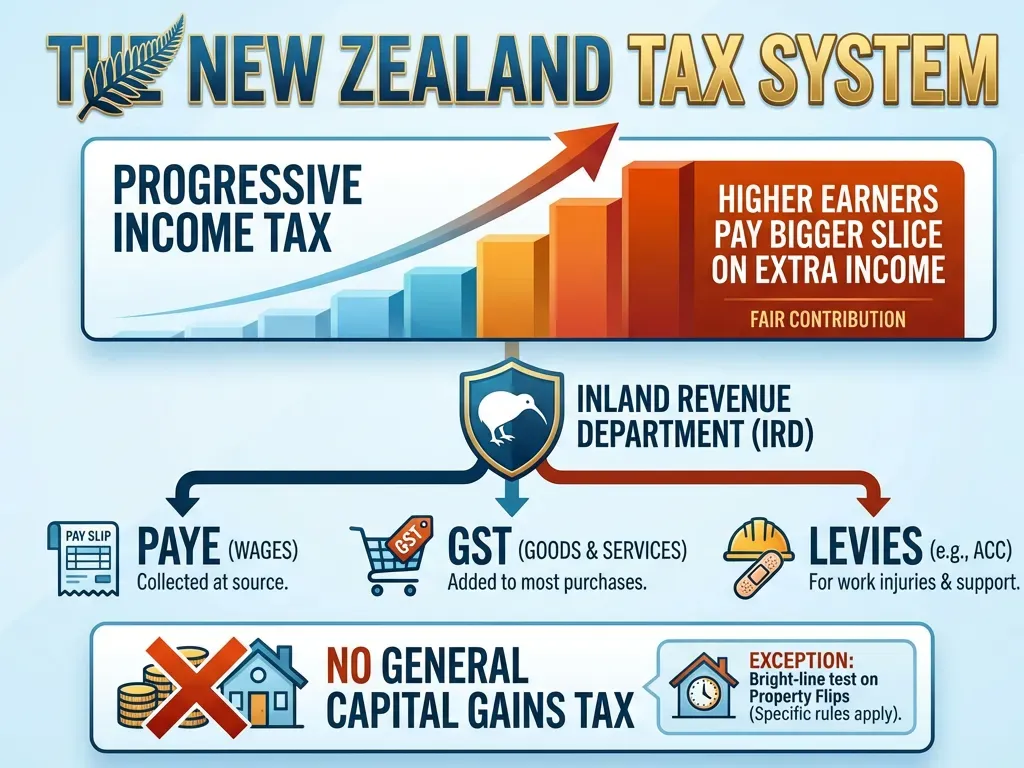
Ever wondered why your paycheck shrinks more than expected, or how that 15% added to your coffee bill funds our roads and hospitals? You're not alone—navigating the NZ tax system basics like PAYE, GST...