Rent vs Buy Calculator: Should You Keep Renting?

Ever stared at your weekly rent payment and wondered if it's time to stop throwing money away and buy a home instead? Or maybe you're questioning if keeping that rental flexibility is smarter in today...
James writes about the New Zealand property market, renting, home ownership, and housing costs. He breaks down complex property topics into practical advice for renters and buyers.
Ever stared at your weekly rent payment and wondered if it's time to stop throwing money away and buy a home instead? Or maybe you're questioning if keeping that rental flexibility is smarter in today's Kiwi market. With house prices stabilising but mortgage rates hovering around 6-7% in 2026, the Rent vs Buy Calculator: Should You Keep Renting? debate is more relevant than ever for Kiwis facing tough choices.
In New Zealand, median rents for a three-bedroom house sit at about $450 per week nationally, while buying involves not just mortgage repayments but rates, insurance, and maintenance adding up to another $70+ weekly. But does owning build wealth faster, or does renting let you invest elsewhere? We'll break it down with practical tools, real NZ examples, and a step-by-step guide to decide if you should keep renting.
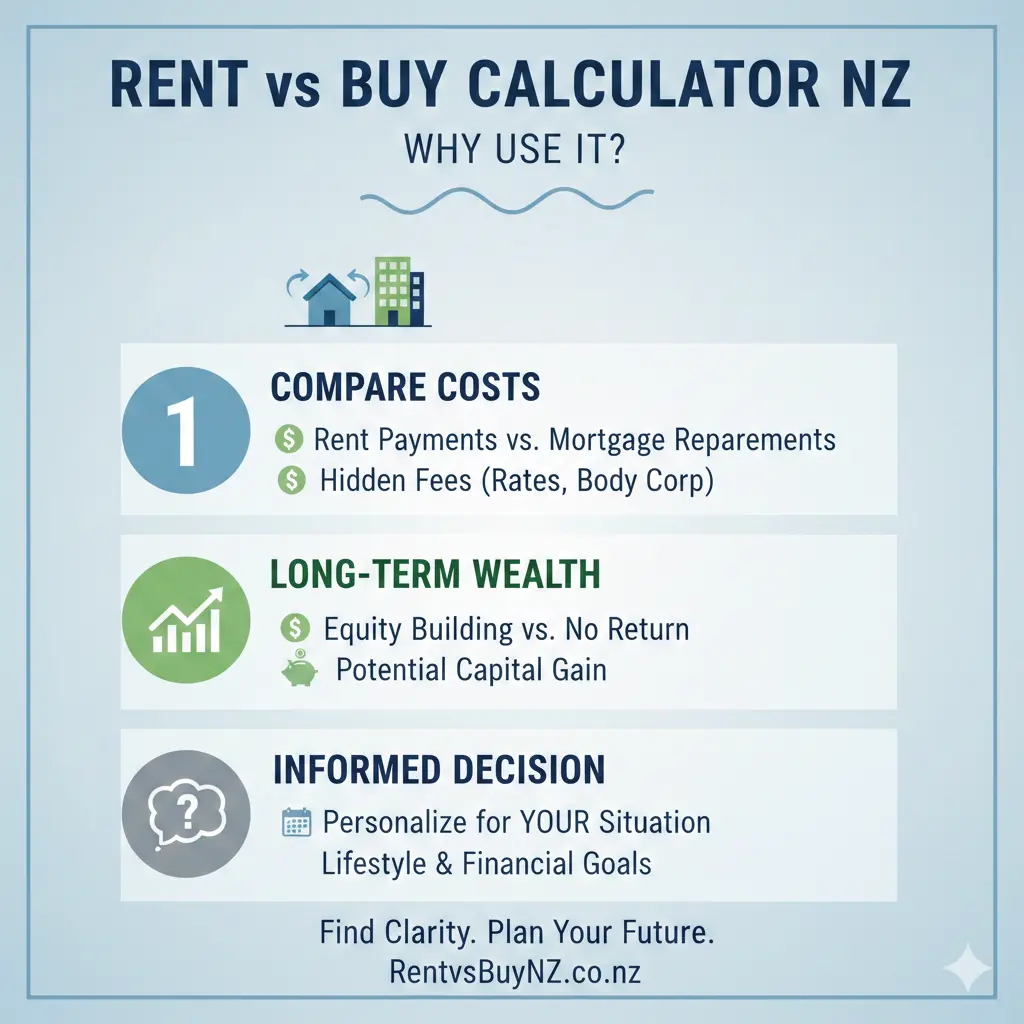
Why Use a Rent vs Buy Calculator in New Zealand?
A rent vs buy calculator crunches the numbers on your specific situation, comparing total costs over time—like 5, 10, or 20 years. It factors in Kiwi realities: rising rents (typically 3-5% annually), house price growth (historically 4-6% but slower lately), KiwiSaver contributions, and even opportunity costs of your deposit money.
Unlike generic overseas tools, NZ-specific calculators from sites like buyvsrent.co.nz or Lyfords account for local mortgage rules—no LVR restrictions for owner-occupiers over 20% deposit since 2021—and costs like ACC levies or council rates varying by region. In Auckland, where median three-bed rents hit $550/week, the calculator might show renting cheaper short-term, but buying pulling ahead after year 1 in some scenarios.
Key Factors Unique to Kiwis
- Interest Rates: In 2026, expect 6.25-7% for most fixed mortgages. Plug in your pre-approved rate for accuracy.
- Deposit and KiwiSaver: First-home buyers can use KiwiSaver withdrawals plus Healthy Homes upgrades if renting.
- Rent Increases: Capped by market but often 3-5% yearly; Healthy Homes standards add landlord costs passed to tenants.
- Hidden Ownership Costs: Rates ($2,000-4,000/year), insurance ($1,500+), maintenance (1% of home value annually).
How Rent vs Buy Calculators Work
These tools simulate two paths: renting (pay rent, invest the deposit difference in shares or term deposits) versus buying (build equity, pay down mortgage). Outputs include net wealth after your timeline, crossover point (when buying overtakes), and price-to-rent ratio.
For example, on buyvsrent.co.nz, input a $800,000 Auckland home, 20% deposit ($160,000), $600/week rent equivalent, 6.5% mortgage, 4% house growth, and 7% investment returns. After 20 years, buying might yield $1.39 million net wealth versus $298,000 from renting and investing—buying wins by over $1 million. But tweak to a short 4-year stay, and renting edges ahead due to selling costs.
Price-to-Rent Ratio: Your Quick Check
Calculate it simply: home price ÷ (annual rent × 12). Under 15? Strong buy. 15-20? Neutral—run the full calculator. Over 20? Renting likely better.
| Ratio | Signal | NZ Example (3-bed) |
|---|---|---|
| <15 | Buy | Queenstown $900k / $35k year = 25? Wait, adjust. |
| 15-20 | Neutral | National $513k / $23k year ≈ 22 (favours rent) |
| >20 | Rent | Auckland $1m / $28k year = 35+ |
Nationally, ratios around 18-22 mean it's close—use a calculator for your suburb.
Pros and Cons: Renting in NZ
Advantages of Keeping Renting
- Flexibility: No selling stress if jobs move you—vital with Kiwi mobility via WINZ relocations or overseas ops.
- Lower Upfront Costs: Just 4 weeks' rent bond + 2 weeks advance; invest your savings in KiwiSaver (8% avg returns).
- Cheaper Short-Term: Interest.co.nz shows renting takes 26.4% of after-tax income vs 26.5% for buying nationally.
- No Maintenance Headaches: Landlords handle Healthy Homes compliance, rates hikes.
Disadvantages of Renting
- Rent keeps rising—$450/week median now, potentially $600+ by 2030.
- No equity buildup; you're building landlord's wealth.
- Tenancy Tribunal risks if landlord sells (90-day notices).
- Wealth Building: Equity grows with payments; capital gains tax-free for main home.
- Stability: Lock in costs; no rent hikes.
- Government Help: First Home Grant up to $10k, KiwiSaver withdrawal, low-deposit options via Kāinga Ora.
- Forced Savings: Mortgage principal reduces debt.
- High Upfront: 20% deposit on $800k home = $160k; plus legal/moving $10k+.
- Ongoing Costs: Mortgage $800+/week + $70 rates/ins/maint.
- Illiquid: Hard to sell quickly without loss in soft markets.
- Rates Risk: 2026 council hikes possible post-elections.
- Gather Numbers: Current rent, home price (realestate.co.nz), mortgage rate (get pre-approval), deposit, timeline.
- Pick a Tool: Try buyvsrent.co.nz (free, instant) or download Lyfords/YourMoneyBlueprint Excel.
- Input Assumptions: Rent rise 4%, house growth 4%, investments 7% (NZ shares/ETFs), maintenance 1%.
- Review Outputs: Check crossover, net wealth, break-even.
- Sensitivity Test: What if rates hit 8%? House prices flat?
- Consult Pros: Mortgage adviser (settled.govt.nz), financial mentor via MoneyTalks.
Pros and Cons: Buying a Home in NZ
Advantages of Buying
Disadvantages of Buying
Real Kiwi Scenarios: When to Rent vs Buy
Auckland Young Professional: $120k household income, eyeing $900k home (ratio 32), 10% stay. Renting wins—high ratio, short term. Invest deposit at 7% instead.
Wellington Family: $700k home (ratio 18), 10+ years, stable jobs. Buying builds $500k+ equity. Use First Home Loan for 5% deposit.
Regional Kiwi (Christchurch): $600k home (ratio 16), median rent $420/week. Neutral—calculator shows buy-ahead at year 3.
Step-by-Step: Run Your Own Rent vs Buy Calculation
Other Factors Beyond the Numbers
Money isn't everything. Lifestyle matters: love hosting? Buy. Value travel? Rent. Also consider KiwiSaver balance (can't access till 65 if renting long-term), family plans (schools tied to zones), and market shifts—2026 forecasts show modest growth outside Auckland.
Tax perks: No bright-line test for your home; rental properties face 39% top rate on gains if sold soon.
Next Steps: Make Your Decision Today
Grab a coffee, pull up buyvsrent.co.nz, and run your numbers—it's free and takes 5 minutes. If buying appeals, chat to a settled.govt.nz adviser or check ird.govt.nz for grants. Renting? Boost KiwiSaver and shop Tenancy Services for fair deals. Whatever you choose, it's about suiting your life, not FOMO. In 2026's market, informed Kiwis win.
Frequently Asked Questions
Sources & References
-
1
Rent or Buy? - Interest.co.nz — www.interest.co.nz
-
2
NZ Buy vs Rent Calculator - buyvsrent.co.nz — buyvsrent.co.nz
-
3
Should I Rent or Buy in 2026? - mmclending.com — mmclending.com
-
4
Own or Rent Calculator NZ - Lyfords — www.lyfords.co.nz
-
5
Buying vs Renting a House - MoneyHub NZ — www.moneyhub.co.nz
-
6
Rental Yield Calculator - Opes Partners — www.opespartners.co.nz
Useful Tools
Related Articles

The Ultimate Rental Inspection Checklist for NZ Tenants
Moving into a rental in New Zealand can feel like a big step, but nothing prepares you quite like acing that first property inspection—or preparing for the regular ones that follow. As a tenant, knowi...

Healthy Homes Standards: A Guide for NZ Landlords & Renters
If you're renting or managing a property in Aotearoa, you've probably heard about the Healthy Homes Standards. These legal requirements aren't just bureaucratic boxes to tick—they're designed to ensur...

Renter's Rights in New Zealand: Know Your Protections
Imagine signing a lease only to face unexpected repairs, unfair rent hikes, or eviction threats—that's the reality too many Kiwis have faced. But with the Renters' Rights in New Zealand evolving throu...

Tenancy Law Changes 2025: What Renters Need to Know
If you're renting in New Zealand, the tenancy law changes kicking in from early 2025 could reshape your rights and responsibilities as a tenant. These updates to the Residential Tenancies Act (RTA) br...